Little Round Top is the granite slope at Gettysburg where the 20th Maine fixed bayonets. Reenactors filming there in 1993 say a worn old soldier handed them live period cartridges, said his piece, and walked off. Nobody could place the man.
On Little Round Top, the granite hill on the southern end of the Gettysburg battlefield in Pennsylvania, the story reenactors still pass around starts during a film shoot. In 1993, a crew was making *Gettysburg* on the actual ground, and between takes a few Union reenactors were resting on the slope when an old man walked up to them. He was haggard and dirty, in a worn Civil War uniform, and as the story is told he said something like "rough one today, ay boys?" and pressed a few musket rounds into their hands before walking off.
The rounds turned out to be authentic period cartridges. Nobody on the production had issued them, and nobody could place the man.
No record backs that up. It lives only as reenactor folklore, retold on ghost sites. What is documented is the shoot itself: *Gettysburg* was the first motion picture the National Park Service allowed to stage battle scenes on the real battlefield, and thousands of reenactors turned out with their own period uniforms, muskets, and gear.
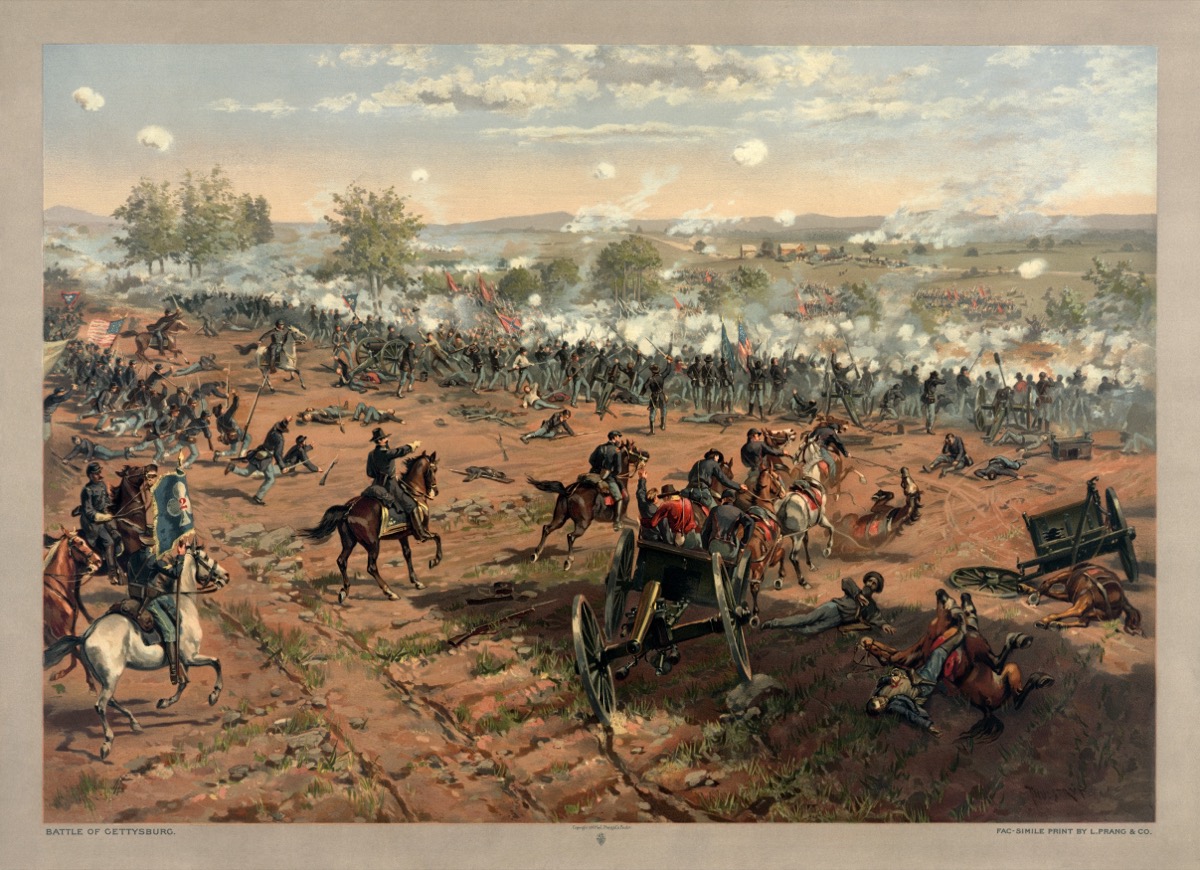
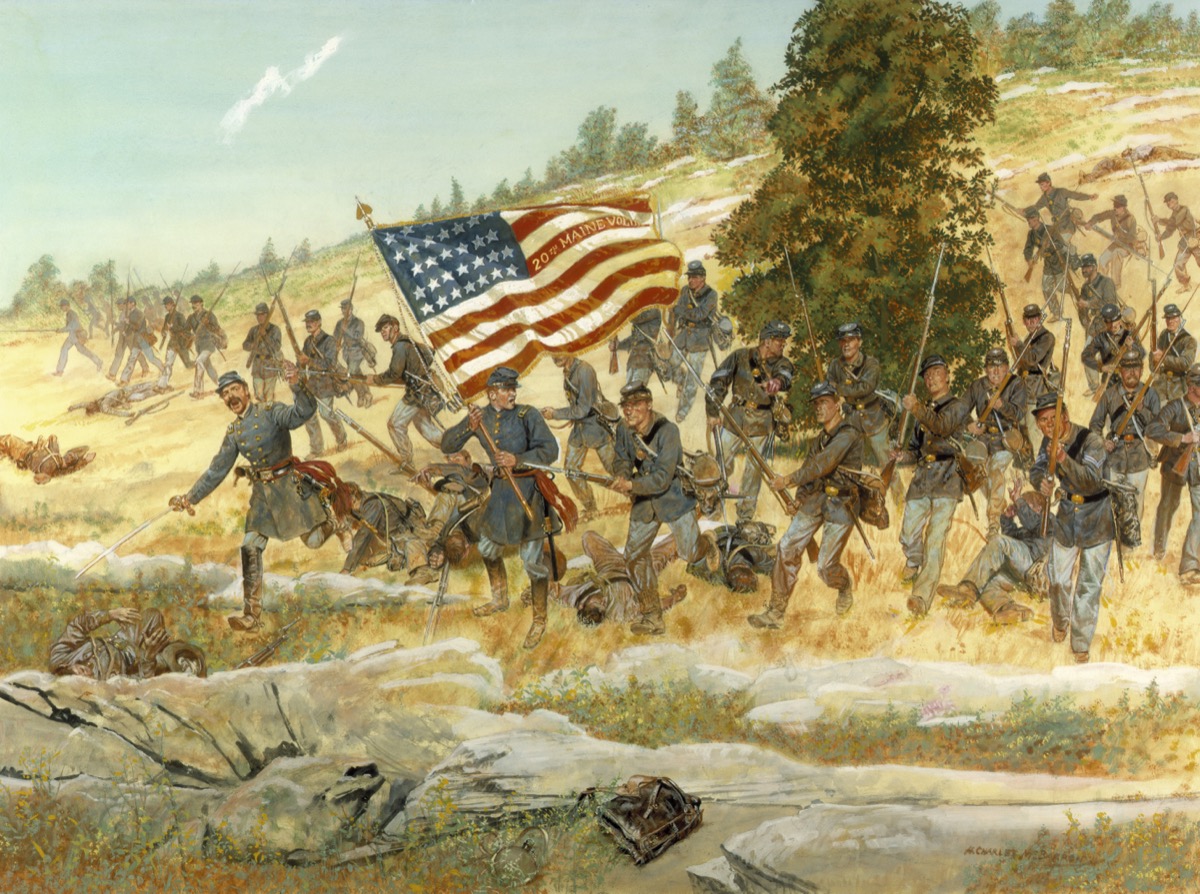
The hill earned the haunting. On July 2, 1863, this slope held the extreme left flank of the Union line. The engineer Gouverneur Warren spotted the hill nearly undefended and rushed troops up to hold it. Colonel Joshua Chamberlain and roughly 385 men of the 20th Maine took the 15th Alabama's attacks uphill for about ninety minutes. When they ran out of ammunition, Chamberlain ordered his men to fix bayonets and charge down into the advance. It held. Of the 2,996 Union troops engaged here, 565 were casualties. Strong Vincent, who put his brigade on the slope, was mortally wounded, and the men who saved the hill mostly didn't leave it.
The phantom soldier isn't even the oldest story tied to this fight. Ghost-lore author Mark Nesbitt traced one to the night before, when the Union Fifth Corps was marching into Gettysburg and the soldiers spotted a mysterious horseman in the darkness ahead, dressed in Revolutionary War-era clothing. Some of them believed it was George Washington's ghost, riding out to meet the army before the worst day of its life.
In the saddle below sits Devil's Den, the boulder field where visitors keep reporting cameras and phones that fail among the rocks, gunfire and screams with no source, and figures that turn up in photographs nobody saw through the lens.
So the old man pressed a few rounds into reenactors' hands and walked off, and the rounds were real. On a hill where Chamberlain's men ran out of ammunition and went down the slope with bayonets, somebody had ammunition to spare.