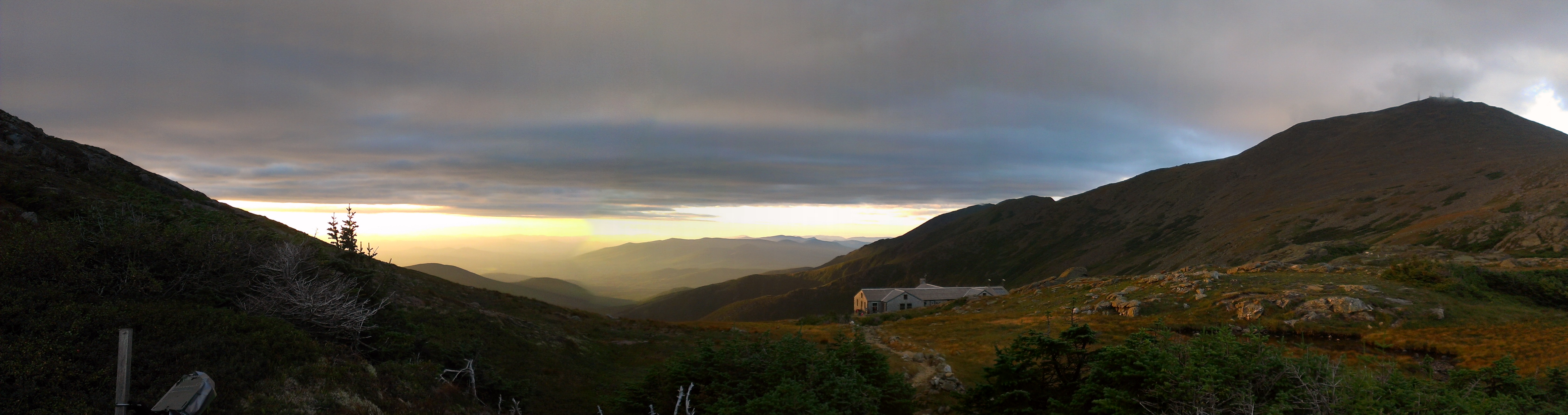
Lakes of the Clouds Hut sits at 5,000 feet on Mount Washington, on the spot where a hiker froze to death in 1900. The story the crew tells is of a man sent up alone one spring, found shaking in a cabinet under the kitchen sink.
Lakes of the Clouds Hut is a stone bunkhouse perched at roughly 5,000 feet on the southern shoulder of Mount Washington in New Hampshire, the highest and largest of the Appalachian Mountain Club's White Mountain huts. The story the crew tells starts with a man they call George.
One spring, before the hut opened for the season, George was sent up alone to inspect the still-shuttered building. The way it's retold by Marianne O'Connor in *Haunted Hikes of New Hampshire*, he saw something through the windows. He reported a distorted human face pressed against the glass, chasing his gaze from one pane to the next, then melting through the glass into the room and heading right at him. When the crew came up, they found George hidden in a cabinet under the kitchen sink, shaking and whimpering in terror. He never returned to the hut.
Understand why the place feels like that, and you have to go back to why it's there at all. On June 30, 1900, two men were hiking the Crawford Path up to a club meeting on the summit when a summer blizzard caught them above treeline. William Curtis, 63, died of hypothermia near the spot where the hut now stands. Allan Ormsbee, in his late twenties, made it a few hundred feet from the summit before he died too. The Appalachian Mountain Club built a shelter near where Curtis fell. That shelter, raised in 1901 and rebuilt as a full hut in 1915, is the building the crew sleeps in now.
So the busiest hut in the White Mountains is, at its origin, a marker for people the mountain killed. And it has killed many: the register for the Presidential Range documents 178 deaths, most from weather and exposure rather than falls. The summit observatory once clocked a wind gust of 231 mph, still the record for a directly measured surface wind on the continent. The hut itself sits about a mile of bare, exposed rock below that summit, beside two small alpine tarns on the col below the cone. It is the last roof before the most lethal stretch of trail in the Northeast.
Curtis and Ormsbee both got crosses on the mountain, and Ormsbee got a memorial plaque on the Crawford Path. O'Connor warns against speaking ill of either man as you pass it. "Do not say 'those fools, what were they thinking?'" she says. "You will be hit in your gut by a force if you criticize William Curtis and Allan Ormsbee." The hut stands where one of them lay down in the cold and did not get up.