The service alley behind the old Iroquois Theatre in Chicago has a name from a newspaper headline: Death Alley. People who cut through it say a voice calls them by name and a cold hand lands on the shoulder. In 1903, 602 died here in fifteen minutes.
There's a narrow service alley behind a Broadway theater in downtown Chicago, between Randolph and Lake, where trucks park by day and people cut through on foot. Its real name is Couch Place. A newspaper headline gave it the other one: Death Alley. People who pass through it report being grabbed — a cold hand on the shoulder, a voice calling them by name, someone walking close behind who isn't there.
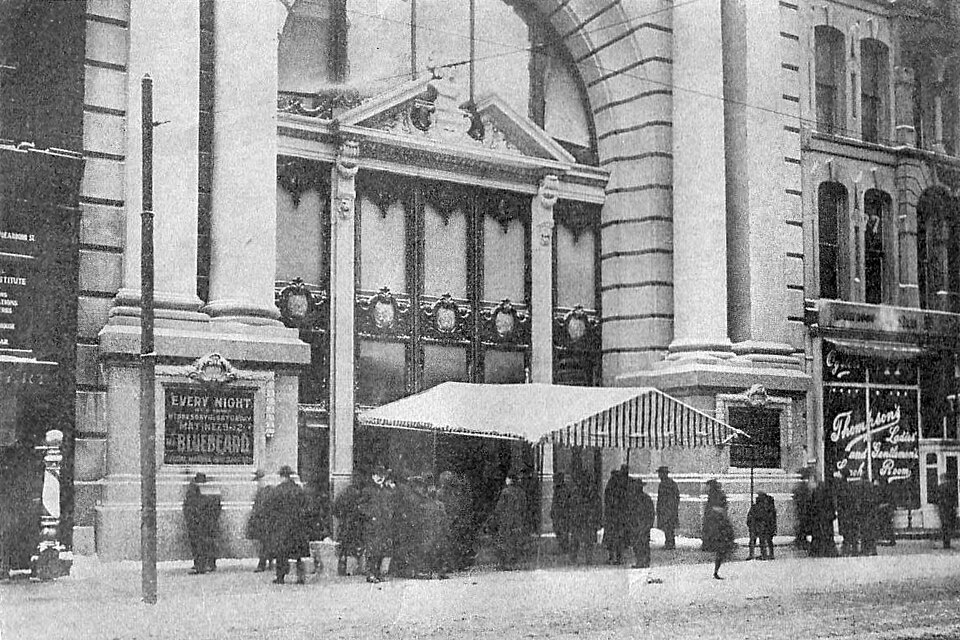
The reason is dated December 30, 1903. The Iroquois Theatre had been open about five weeks and advertised itself as "absolutely fireproof." That afternoon it was packed for a holiday matinee of "Mr. Bluebeard," the house full of women and children on school break — by one count, ten of them for every man. During the second act, a spark from a stage arc light caught a muslin curtain.
The asbestos safety curtain came down to seal the stage off, then jammed. It had snagged on a light reflector jutting from the proscenium and wouldn't close. Then someone opened a rear stage door, and the rush of cold outside air drove a fireball straight out into the auditorium.
The crowd ran for exits that didn't work. Doors locked, doors opening inward, doors hidden behind drapery, unfamiliar latches. People stacked against them. Others reached the fire escapes out back and found them incomplete, and more than a hundred fell or jumped into the alley below.
In about fifteen minutes, 602 people died — the deadliest single-building fire in American history. The dead were carried into Couch Place and laid out in rows. A headline the next morning called it Death Alley, and the name stuck.
Every push-to-exit door you've ever leaned on traces back to these deaths. The footprint is now the active James M. Nederlander Theatre at 24 W. Randolph, where cast members report shadow figures in the balcony and people in turn-of-the-century clothing on the back stairs. But the alley is the same alley. It was never rebuilt, only renamed.