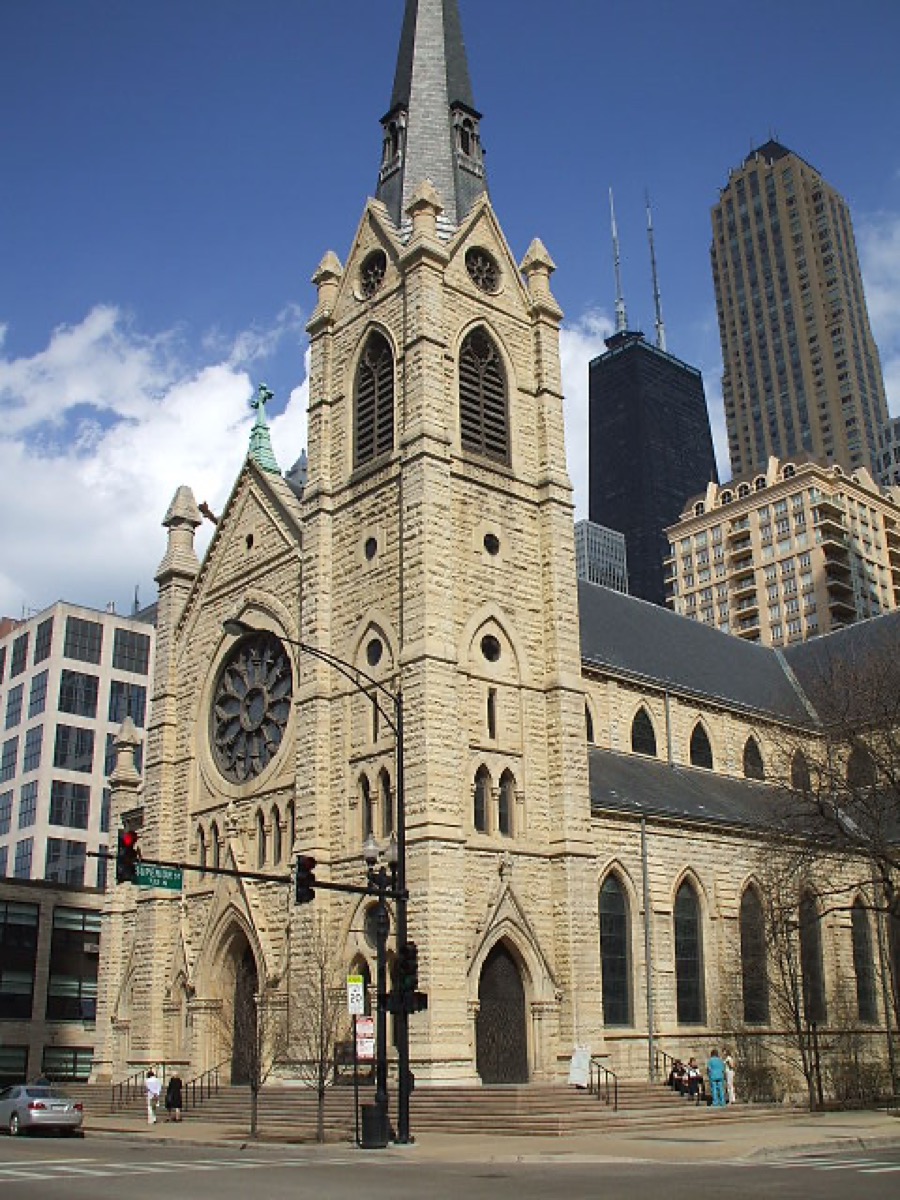
The cornerstone of Holy Name Cathedral in Chicago still carries bullet scars from the day a North Side Gang boss was machine-gunned in the street out front. The cathedral has tried to patch them. The mortar won't set, the legend says. The holes stay.
The cornerstone of Holy Name Cathedral in Chicago is carved with a line of scripture, and part of it is missing. Bullets took out the middle. What's left reads as a fragment: "Every knee should heaven and on earth."
The holes came from across the street. On the afternoon of October 11, 1926, Hymie Weiss, boss of the North Side Gang, was walking back toward his headquarters when gunmen opened fire from a rooming house with a submachine gun and a shotgun. They hit him many times and killed him where he stood. His associate Paddy Murray died beside him; three other men with them were wounded but lived. Stray rounds carried across the street into the cathedral's cornerstone and blasted the words around "bow, of those in" clean off the carved Latin, leaving the kneeling line broken in two.
The cathedral has tried to fix the marks. The story goes that the holes won't take a repair, that the mortar either never hardens or falls back out soon after, and the scars stay open. No engineering report or church statement backs that up; it's a legend the ghost tours carry. But the holes are still there a century on, and newlyweds married at the cathedral are said to run their hands over them for luck.
It wasn't the first killing this corner watched. Two years earlier, Dean O'Banion, who'd sung in the Holy Name choir as a boy and went by "Deanie," was shot dead in his flower shop across the same street. A rival gripped his hand in a handshake to pin it while two others fired five shots into him. Because he ran a bootlegging gang, the archdiocese refused him a burial in consecrated ground.
A ghost-tour guide named Tony Szabelski says Weiss never left the spot where he died. "Anytime we come here on tours, we bring out ghost-hunting equipment," he told CBS Chicago, "we would get a lot of 'yes' and 'no' answers." The church has never said a word about any of it. The cornerstone just keeps refusing to heal.