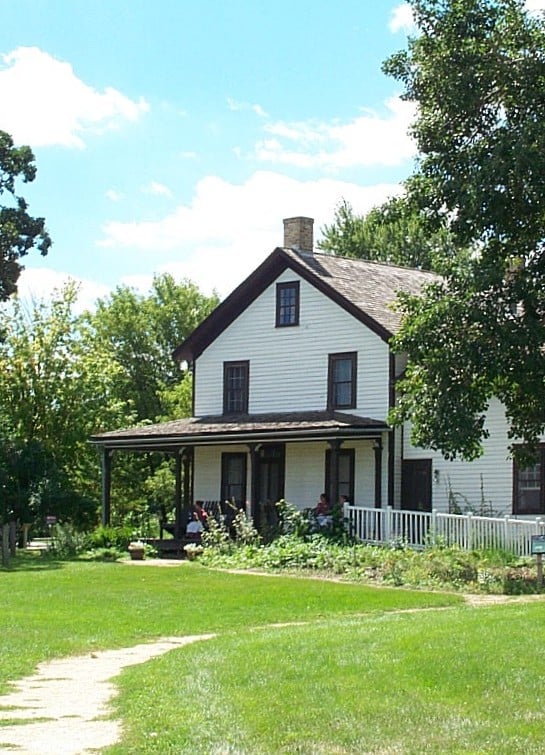
At Gibbs Farm in Falcon Heights, Minnesota, staff and visitors keep running into a small boy who rocks an upstairs chair and pulls toys from a locked case. The historical society's own records name a Gibbs child who died at 9, the same year the house was finished.
At Gibbs Farm in Falcon Heights, Minnesota, the ghost people report is a small boy. He rocks a chair upstairs with no one in it. He opens and shuts cupboard doors. And overnight, toys get pulled out of a locked display cabinet and left scattered across the floor of an upstairs room — playful, restless mischief, exactly what you'd expect of a child who never grew up.
The farm is a living-history museum now, run by the Ramsey County Historical Society on the old homestead of Heman and Jane Gibbs. They started here in 1849 in a sod house barely ten feet across. The one-room farmhouse went up in 1854 and grew to eight rooms by 1867. The house and barn made the National Register of Historic Places in 1975.
That last year matters. In 1867, the Gibbs' third child died. His name was William Wallace Gibbs — Willie — and he was 9 years old. The historical society's own family records keep the cause plain: he died from an illness brought on by smoke inhalation from a planned burn on the farm. Ghost-story sites tend to dress this up into a prairie fire that threatened the house. The family's own wording is quieter than that, and worse for it. No blaze. Just smoke, and a sick boy who didn't recover. His siblings grew up and grew old here — Abbie spent her whole life in the farmhouse caring for their parents. Willie didn't get the chance.
The staff don't seem to need much convincing about who's still here. Visitors, tour guides, and a grounds patrolman have all described the same thing over the years: footsteps in the hallway behind the kitchen, rising toward the second floor, with no one found at the top of the stairs. A rocking chair on that floor is heard going on its own.
One patrolman is said to have looked up from the grounds and seen the face of a boy watching him from a second-story bedroom window. A tour guide, on another day, reported a boy standing in a window who simply wasn't there a moment later.
The museum itself doesn't tell you any of this. It runs school field trips and not-so-scary Halloween events, and it leaves the ghost out of the brochure entirely. The boy stays anyway — in the house his family kept finishing the year he stopped growing up.