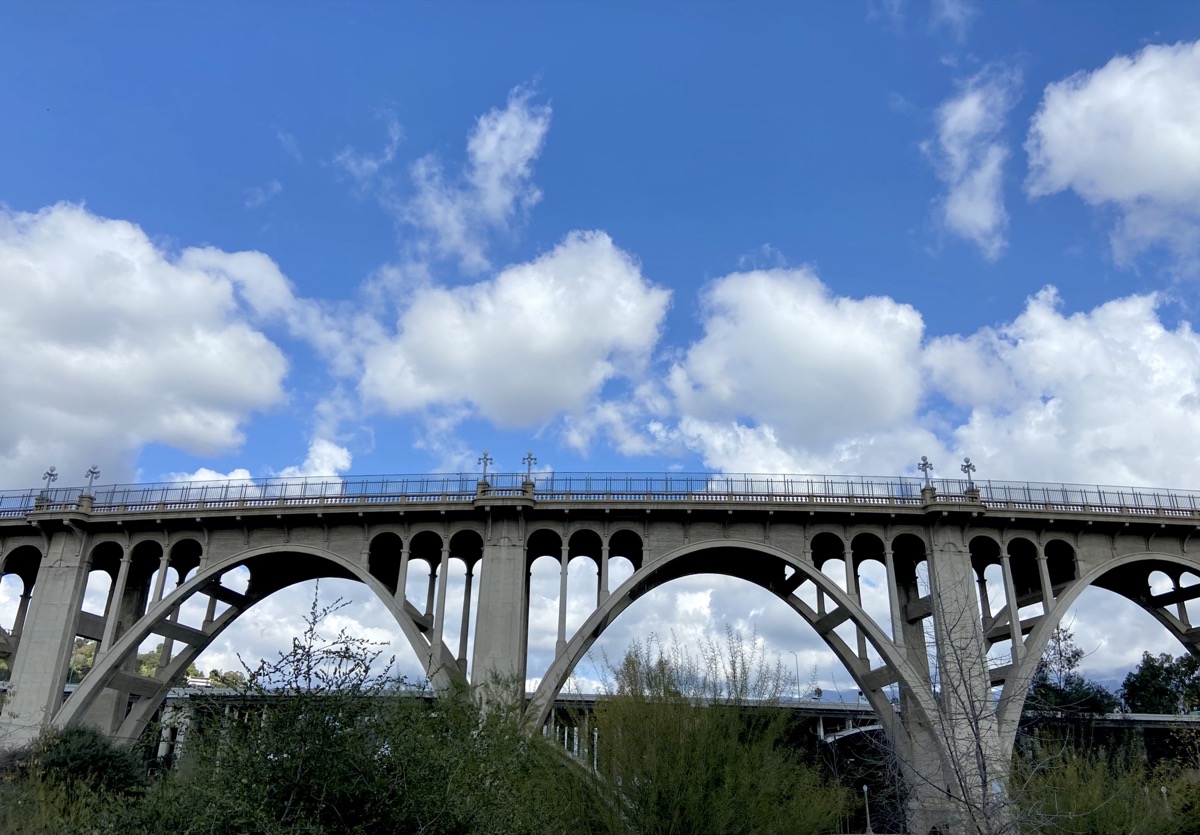
The Colorado Street Bridge in Pasadena, California rises 150 feet over the Arroyo Seco. People who walk it report a robed woman on the parapet who vanishes mid-fall, a man in wire-rimmed glasses pacing the deck, and cries rising from the riverbed below.
At the Colorado Street Bridge in Pasadena, California, the story people tell is about a woman in a long, flowing robe. She stands atop one of the parapets, the accounts go, and then she vanishes as she throws herself off the edge — gone before she reaches the arroyo 150 feet down.
She isn't the only one. A spectral man in wire-rimmed glasses is said to pace the deck. And from the riverbed below, where houses sit in the Arroyo Seco, residents report unexplained cries and figures that don't stay long enough to name.
There's a reason the lore settled here. The Beaux-Arts arch opened in 1913, curving roughly 50 degrees to the south because the engineers couldn't find solid footing in the wet arroyo bed and bent the whole span to reach it. It was beautiful — classical balusters, cast-iron lamp posts — and within a few years it had a second name the town still uses. By the late 1920s people were calling it Suicide Bridge.
The deaths were real. The first documented one came in 1919, and they rose sharply through the Depression. More than 100 people have died from the bridge over the past century, though the early records are incomplete. One of the grimmest cases was in 1937, when a despondent young mother threw her three-year-old daughter off the edge and then jumped. The mother died. The child's fall was broken by the trees below, and she lived — returning to Pasadena, by one account, for the bridge's reopening in 1993.
The founding ghost, though, is older than any of them: a worker said to be entombed in one of the piers, fallen headfirst into wet concrete during construction and sealed in when his coworkers couldn't free him. A falsework collapse did kill and injure workers. But a Pasadena resident's correction notes that no body was ever left in the cement. The legend held anyway.
The city has spent years trying to make the bridge safe without ruining the historic look that put it on the National Register: a 1993 prevention rail, a 10-foot temporary fence in 2018, a permanent barrier still in design. The robed woman keeps her place on the parapet regardless.