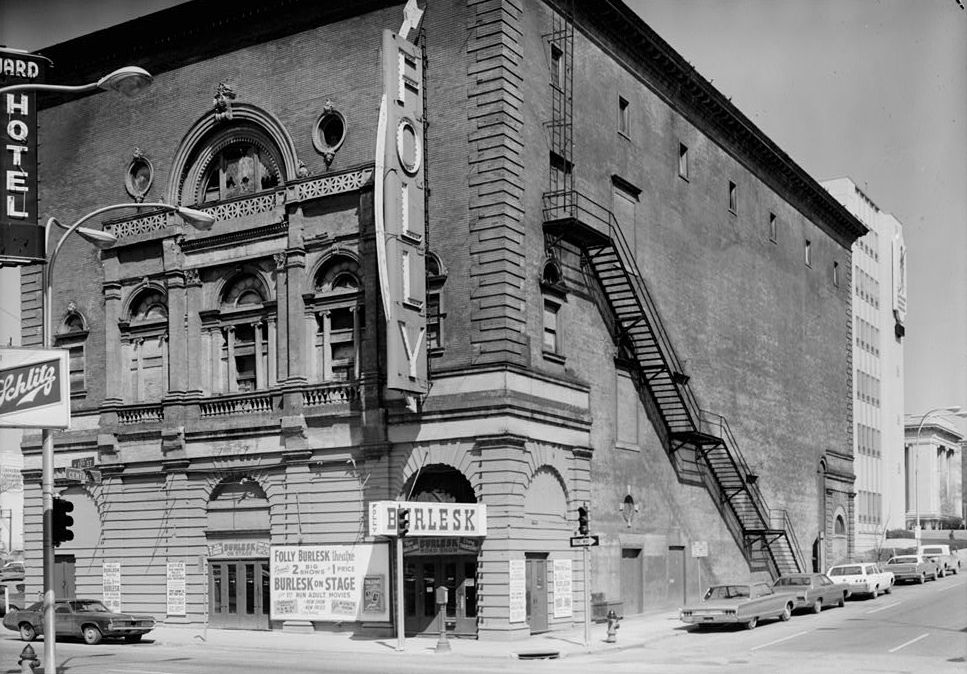
The resident ghost at the Folly Theater in Kansas City, Missouri wears a top hat and tails, just like Joe Donegan, the manager who ran the place from 1900 to 1922. A police officer reported seeing him at the bar long after the man was dead.
A police officer once looked through a window of the Folly Theater in Kansas City, Missouri, while the building sat dark and locked, and saw a gentleman at the bar in a white top hat and tails. Staff hurried over with the keys. By the time they got the door open, there was no trace of the man.
The Folly's director of development, Brian Williams, knows why the costume matters. The officer "saw what appeared to be a gentleman with a white top hat and tails," he said. "By the time they got there with their keys, they couldn't find any trace of this person. Turns out, Donegan always wore a top hat and tails."
Joe Donegan ran the theater and its adjoining hotel from roughly 1900 to 1922, back when the place was called the Standard, then the Century. They called him the Angel of Twelfth Street. He booked the Marx Brothers, Gypsy Rose Lee, Jack Dempsey, and Jack Johnson onto the stage at 300 West 12th Street, and a young Humphrey Bogart trod those boards in 1924. Decades after Donegan died, people kept describing a man in his clothes. A former custodian saw a figure in a bowler hat. The officer at the window saw the top hat and tails.
Kate Egan ran theater operations here from 1998 to 2004, and the sightings weren't a one-off she heard about secondhand. "I've had multiple phone calls from people saying they had seen him," she said. "They'd had conversations with him."
He isn't the only one. Staff working the lobby once heard piano music drift out of the auditorium for several minutes; when they peeked inside, the piano sat alone on stage, no one at the keys. And patrons describe a woman in a long gown rushing toward the stage, as though she's late for a cue that was called a century ago. No one has put a name to her.
The Folly opened on September 23, 1900, and very nearly didn't survive. By the 1970s it was a faded burlesque house slated for the wrecking ball. Civic leaders bought it for $500,000 to save it, restored it, and reopened it in 1981 with Walter Cronkite as honorary chairman. It runs today, freshly renovated and 125 years old, a working theater again.
The man at the bar has watched the building get gutted, renamed, and rebuilt around him. A young girl who visited once held a long conversation with a man in costume. They talked about the downstairs grill, a room that was torn out of the building decades before she was born.