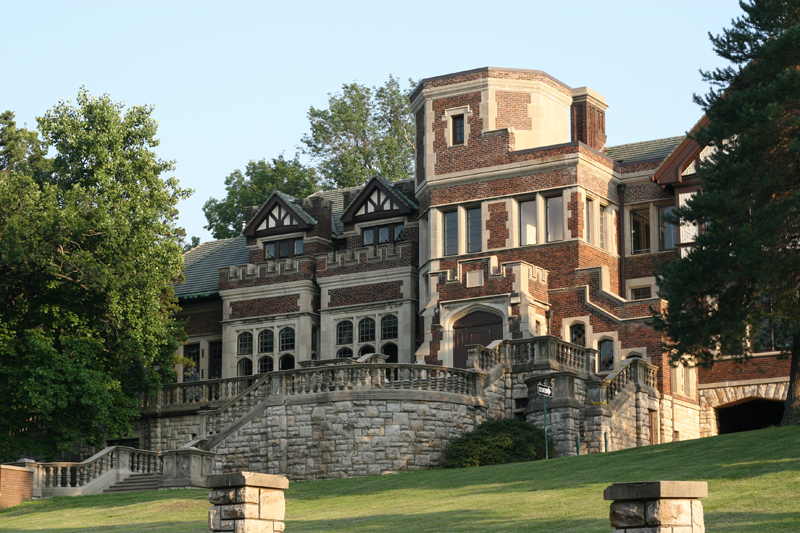
At Epperson House on the UMKC campus in Kansas City, the sound people keep reporting is a pipe organ playing at night in the empty mansion. It was designed by Harriet Barse, who died before the instrument was ever finished, and the music started after she was gone.
The men who lived in the dorm rooms at Epperson House used to hear an organ. It came from the loft at night, in a Tudor-Gothic mansion on the UMKC campus in Kansas City, Missouri, where no one was playing and the loft stood empty. Night guards reported it after them, and the reports never really stopped.
The organ was real, and the story of how it got there is the whole story.
Uriah Epperson, who'd made his fortune in meat-packing and insurance, built the 54-room house at 5200 Cherry Street between 1919 and 1923. It ran him close to half a million dollars, and Kansas City started calling it Epperson's Folly. Inside were six bathrooms, elevators, a Grecian-tiled swimming pool, a barbershop, and a tunnel connecting the east and west wings. At the center of it was a grand hall built around an organ loft.
The instrument that loft was made for came from a woman named Harriet Barse. She was an organ student at the Kansas City Conservatory, and the Eppersons brought her into the house and called her their adopted daughter, though nothing was ever filed. She drew up the plans for the pipe organ herself, fitted to that loft. Then, on December 20, 1922, before any of it was built, she died of a perforated gallbladder. She was 47.
The Reuter Organ Company of Lawrence, Kansas built her instrument anyway. It was dedicated on November 29, 1925, nearly three years after she was gone. She never heard a note of it.
People say she came back to hear it. They've reported her near the grand staircase in an evening gown, as if dressed for a recital. The house passed to the University of Kansas City in 1942 and served as a men's dorm until 1956, and the music kept turning up the whole time.
There's a darker version told about the place — that Uriah lost his mind after Harriet died, murdered his wife, and killed himself. None of it happened. Mary Epperson outlived her husband by twelve years, and when she died in 1939, more than 600 people came to her funeral, held inside the house.
So the murder is a story someone made up. The woman who designed an organ she'd never play is not. The house has stood empty since 2011, and the music people keep describing started only after she was dead.