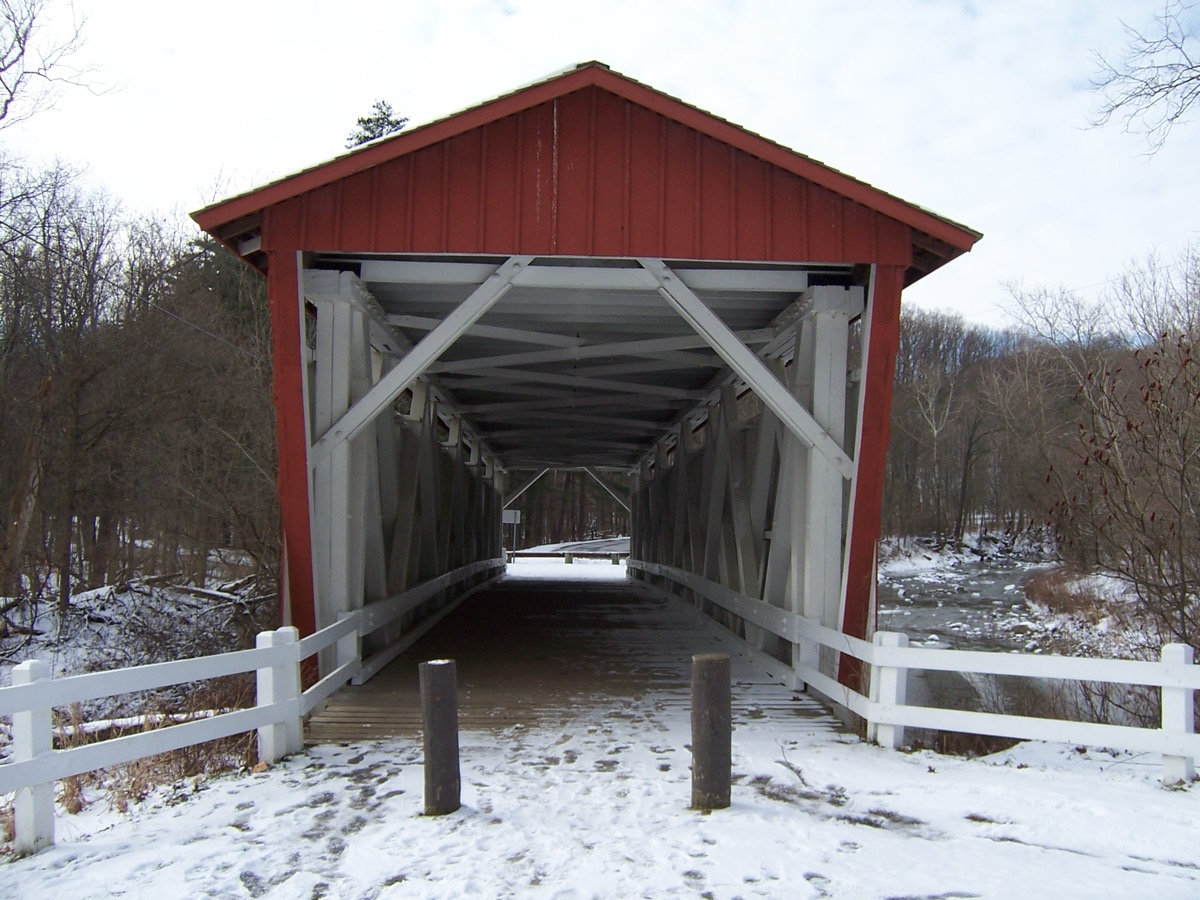
A hitchhiker waits on Everett Road after dark in Cuyahoga Valley National Park, solid enough that drivers pull over for him. He climbs in and is gone. Locals think he's John Gilson, a farmer who drowned in the flooded Furnace Run in 1877 and never made it home.
On Everett Road after dark, on the unlit stretch past the covered bridge in Cuyahoga Valley National Park near Peninsula, Ohio, a man stands waiting for a ride. He looks solid enough that drivers pull over. He climbs in, and somewhere along the road he's gone.
The locals have a name for him. They think he's John Gilson, a valley farmer who drowned at this crossing.
On a winter night in 1877, Gilson and his wife tried to cross the flooded Furnace Run, the creek the bridge spans. She was thrown into the water and pulled out alive. His horse dragged him into deeper water, and he went under. His body wasn't recovered for four days. The story goes that he's still trying to find his way home from the creek that killed him.
Valley legend holds the bridge itself was raised because of his death. No one can pin the year it was built, though, and the records can't say whether it stood here before Gilson drowned or went up after, so even that connection stays a story people tell rather than a fact anyone can prove.
Some who've waited there at night say they hear hooves near the bridge, the same horse, the way it's told, that pulled him into the current. Others report ghostly vapors in their photographs, and partial shapes that weren't standing there when the shutter opened.
There's a competing version. Down the road sits an old burial site, and the ghost-history accounts trace it to a tomb workers supposedly uncovered building the road in 1856. They tell the hitchhiker as a displaced spirit rather than Gilson. No primary record confirms the tomb, so the two theories sit side by side, unsettled.
People who linger near the bridge at night also report disembodied voices "pleading for help as if they are in dire danger." A Cleveland-area couple recording there in September 2019 said they caught two words on tape. One was "Help me." The other was "Beware."
The bridge they all gather under isn't even the original. It had taken hits before, a 1913 flood, a truck in 1970, but a spring storm in 1975 lifted the whole structure off its sandstone abutments and dropped the wreckage in the streambed below. The community raised the money for an accurate rebuild, and the Park Service finished it in 1986. The hitchhiker reports ran straight through the gap, as if whatever waits out on that road doesn't much care whether the bridge is standing or not.