On a hilltop in Elgin, Illinois lies the old state hospital's cemetery, where the oldest stones bear only numbers. The patients arrived without names, and the log matching person to grave was lost. Ghost hunters come for the forgotten, not for any one ghost.
On a hilltop in Elgin, Illinois sits a cemetery where many of the stones have no names on them. They have numbers. The people buried under them came to the state hospital below without names anyone wrote down, died there, and were put in the ground in numbered plots — and the log that matched a person to a number has been lost.
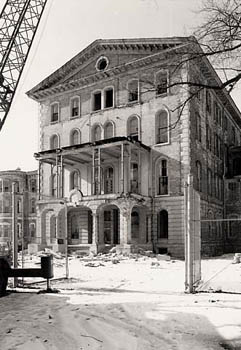
The hospital opened south of town on the bank of the Fox River in 1872, as the Northern Illinois Hospital and Asylum for the Insane. The central building followed the Kirkbride plan: a great brooding pile built for 300 patients. It did not stay that size. By 1930 the population had passed 3,450, and at its peak in the mid-1950s the grounds held roughly 7,700 people. The treatments of that era were what you'd expect — hydrotherapy, cold-water immersion, electroshock.
The cemetery was laid out in 1933 because the dead had nowhere to go. The first burial came that October. About 974 graves followed, nearly all of them patients, the last around 1986. Bodies went into simple wooden caskets, often paid for by the state. The genealogy logs read like a roll call of people no one claimed: a "John Doe" in plot 375, dead November 14, 1948. Entries marked only "Blank." And the small ones — Baby Zolla, Baby Fant, Baby Gillespie, Baby Boy Green.
The Kirkbride building stood 119 years before it came down in the fall of 1993, and by 2008 most of the old complex was gone. What's left is the cemetery and the lore. People drawn to the grounds report tappings, shadows, cold spots, lights inside the old buildings. They say it, but no source ever attaches a name or a witness to any of it.
The story here isn't one spirit. It's 974 of them, kept up now by volunteers, under stones that mostly forgot to say who they were.