About This Location
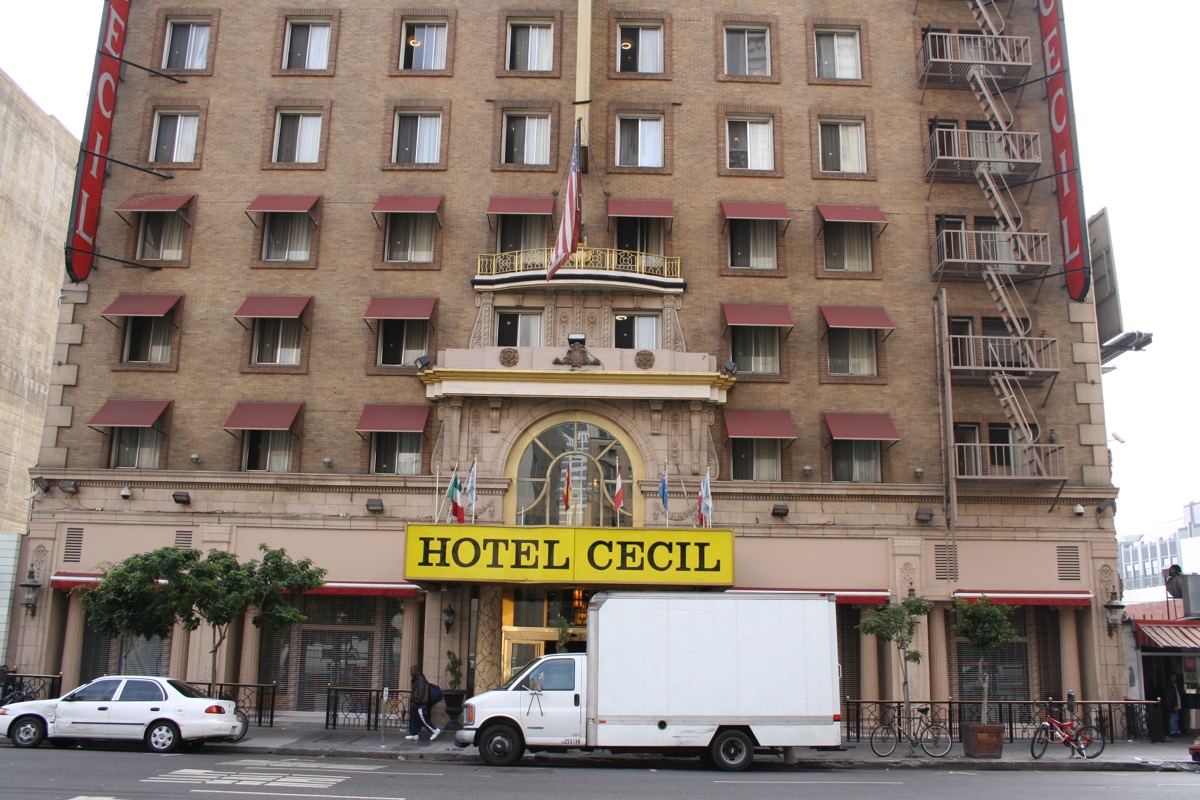
Built in 1924 as an upscale destination for business travelers, the Cecil Hotel's fortunes declined during the Great Depression as Skid Row grew around it. Once known as the "Hotel Death," the Cecil has been the site of numerous suicides, murders, and mysterious deaths since opening. Serial killer Richard Ramirez, the "Night Stalker," stayed here during his 1985 crime spree, as did Austrian serial killer Jack Unterweger in 1991.
The Ghost Story
The Cecil Hotel opened on December 20, 1924, as an opulent destination for business travelers, designed by Loy Lester Smith in the Beaux Arts style. The $1.5 million building featured a grand marble lobby with stained-glass windows, potted palms, and alabaster statuary—a beacon of Los Angeles elegance. But within five years, the stock market crashed, and a darkness settled over the Cecil that would never lift. The surrounding neighborhood deteriorated into what became known as Skid Row, and the hotel transformed from luxury accommodation into a refuge for the desperate, the disturbed, and eventually, the deadly.
The body count began almost immediately. In 1927, Percy Ormond Cook became the first recorded suicide, shooting himself in the head after a dispute with his wife. The deaths accelerated through the Great Depression: W.K. Norton ingested poison capsules in his room in 1931. Benjamin Dodich, 25, was found with a fatal self-inflicted gunshot wound in 1932. Army Medical Corps Sergeant Louis D. Borden, 53, slashed his throat with a razor on July 26, 1934, leaving multiple notes citing chronic illness. In 1937, Grace E. Magro, 25, either fell or jumped from her window, her body found entangled in telephone wires she had ripped from poles during her descent. Dorothy Seger, a 45-year-old teacher, checked in under the name "Evelyn Brent" on January 10, 1940, sent suicide notes to her relatives, then swallowed poison. She died at General Hospital two days later.
The most macabre incident occurred on October 12, 1962, when 27-year-old Pauline Otton jumped from her ninth-floor window after an argument with her estranged husband Dewey. She landed directly on George Gianinni, a 65-year-old pedestrian walking below, killing them both instantly. Police initially believed it was a double suicide until they noticed Gianinni still had his hands in his pockets—impossible if he had jumped. By the 1950s, long-term residents had given the hotel a grim nickname: "The Suicide."
On June 4, 1964, the Cecil witnessed its most brutal murder. "Pigeon Goldie" Osgood, a beloved retired telephone operator known for feeding pigeons in Pershing Square, was found dead in her room by a hotel worker distributing phone books. She had been raped, stabbed, and beaten, her room ransacked. Near her body lay the Dodgers cap she always wore and a paper sack full of birdseed. Police arrested Jacques B. Ehlinger after he was spotted in Pershing Square wearing bloodstained clothing, but he was released without charge. Her murder remains unsolved. Friends from the Cecil and the neighborhood pooled their meager resources to plant flowers in Pershing Square in her memory.
The Cecil's reputation as a magnet for evil crystallized in the 1980s and 1990s when two serial killers made it their home during active murder sprees. In the summer of 1985, Richard Ramirez—the "Night Stalker"—rented a room on the 14th floor for several weeks while terrorizing Los Angeles. He committed at least 13 murders during this period, returning to the Cecil covered in his victims' blood. According to hotel night clerk Raoul Enriquez and tour guide Kim Cooper, Ramirez would walk through the back alley in the middle of the night, strip off his blood-soaked clothes, and stroll barefoot through the hotel in his underwear to his room. "He would walk in his blood-stained underwear, barefoot, up to his floor and into his room. Repeatedly," Cooper noted. "And that's cool, and no one's got a problem with that, because it's that kind of heavy place." Ramirez was captured on August 30, 1985, when a group of LA residents recognized him on the street and held him until police arrived. He was convicted of 13 murders and died on death row in 2013.
Six years later, Austrian serial killer Jack Unterweger checked into the Cecil while on assignment for an Austrian magazine to compare red-light districts. Unterweger had strangled 18-year-old Margaret Schäfer with her own bra in 1974, served 16 years in prison where he became a celebrated author, and was pardoned in 1990 at the urging of Nobel Prize winners Elfriede Jelinek and Günter Grass. The prison warden declared, "We will never find a prisoner so well prepared for freedom." During his Los Angeles stay in 1991, Unterweger murdered three sex workers—Shannon Exley, Irene Rodriguez, and Peggy Jean Booth—all strangled with their bras using his signature knot. The LAPD even gave him a ride-along with a patrol officer during his "research." Unterweger was eventually captured in Miami, extradited to Austria, convicted of nine murders, and hanged himself in his cell the night of his sentencing.
The Cecil's most infamous incident occurred on January 28, 2013, when 21-year-old Canadian student Elisa Lam checked in during a solo trip. She vanished after January 31. On February 13, the LAPD released security camera footage that would become one of the most analyzed videos on the internet. The four-minute clip shows Lam entering the elevator, pressing multiple buttons, peering nervously out the doors as if being pursued, hiding against the wall, and gesticulating wildly as if conversing with someone invisible. The elevator doors remain open the entire time—later explained by internet sleuths who discovered she had accidentally pressed the "Door Hold" button. Her body was discovered on February 19 after guests complained of low water pressure and a strange taste to the tap water. Maintenance worker Santiago Lopez found her in one of the hotel's 1,000-gallon rooftop water tanks. The coroner ruled her death an accidental drowning, with bipolar disorder listed as a significant contributing condition. But the elevator footage, her history of mental illness, and the Cecil's dark reputation spawned countless conspiracy theories.
Paranormal investigators report that the Cecil's accumulated trauma has left permanent spiritual residue. The 14th floor—where Richard Ramirez lived—is considered the most haunted, with guests reporting whispers, flickering lights, and ghostly apparitions. The elevator where Elisa Lam was last seen behaves erratically, with doors opening and closing on their own. Zak Bagans of Ghost Adventures investigated the hotel, capturing an EVP of Elisa Lam's full name in her room and experiencing unexplained cold breezes and equipment malfunctions in the elevator. Visitors report chilling encounters: unexplained cold spots in hallways, phantom whispers when no one is present, disembodied screams, and a recurring apparition of a woman in black believed to be one of the suicide victims. In 2014, an 11-year-old boy photographed what appeared to be a figure hanging outside a fourth-floor window.
The Cecil closed in 2017 for a $100 million renovation, but plans changed after the COVID-19 pandemic. In December 2021, it reopened as affordable housing operated by the Skid Row Housing Trust, providing 600 units to formerly unhoused individuals. The grand marble lobby and Beaux Arts facade remain, designated as a Los Angeles Historic-Cultural Monument in 2017. But the darkness persists: a 2023 Los Angeles Times investigation found black mold, vermin infestations, and deteriorating conditions. Half the units remained empty. The Cecil continues to attract those with nowhere else to go—just as it has for a century.
Researched from 23 verified sources including historical records, local archives, and paranormal research organizations. Learn about our research process.