TLDR
The Capital Hotel in Little Rock won't confirm its ghosts and won't deny them. Staff are told not to discuss. The lore circuit fills the blanks.
The Full Story
The Capital Hotel's official line on its ghosts is "we have no official word." Staff are told not to discuss it. According to the S.P.I.R.I.T. Seekers blog, this is the position the hotel holds in conversation with anyone who asks — a careful corporate non-denial that lets the stories keep circulating without management having to confirm any of them. The hotel won't tell you the place is haunted. It also won't tell you it isn't.
There are two ghosts the lore circuit agrees on. The first is a quiet male laborer said to have died in a fall during construction. The second is a young woman who fell from one of the upper floors. The lore sites disagree on whether she jumped or was pushed.
Here is the catch with the laborer. No primary record confirms anyone died during construction. The S.P.I.R.I.T. Seekers investigator, the most candid of the paranormal-blog writers to tackle the building, put it directly: "I could find no mention of anyone dying while working on the construction of the Capital Hotel." The laborer-ghost is folklore attached to the architecture, not history. The young woman has the same problem. Both versions of her death circulate, neither is sourced, and no one names her.
So the haunting, as a documented thing, is thin. The building, on the other hand, is not.
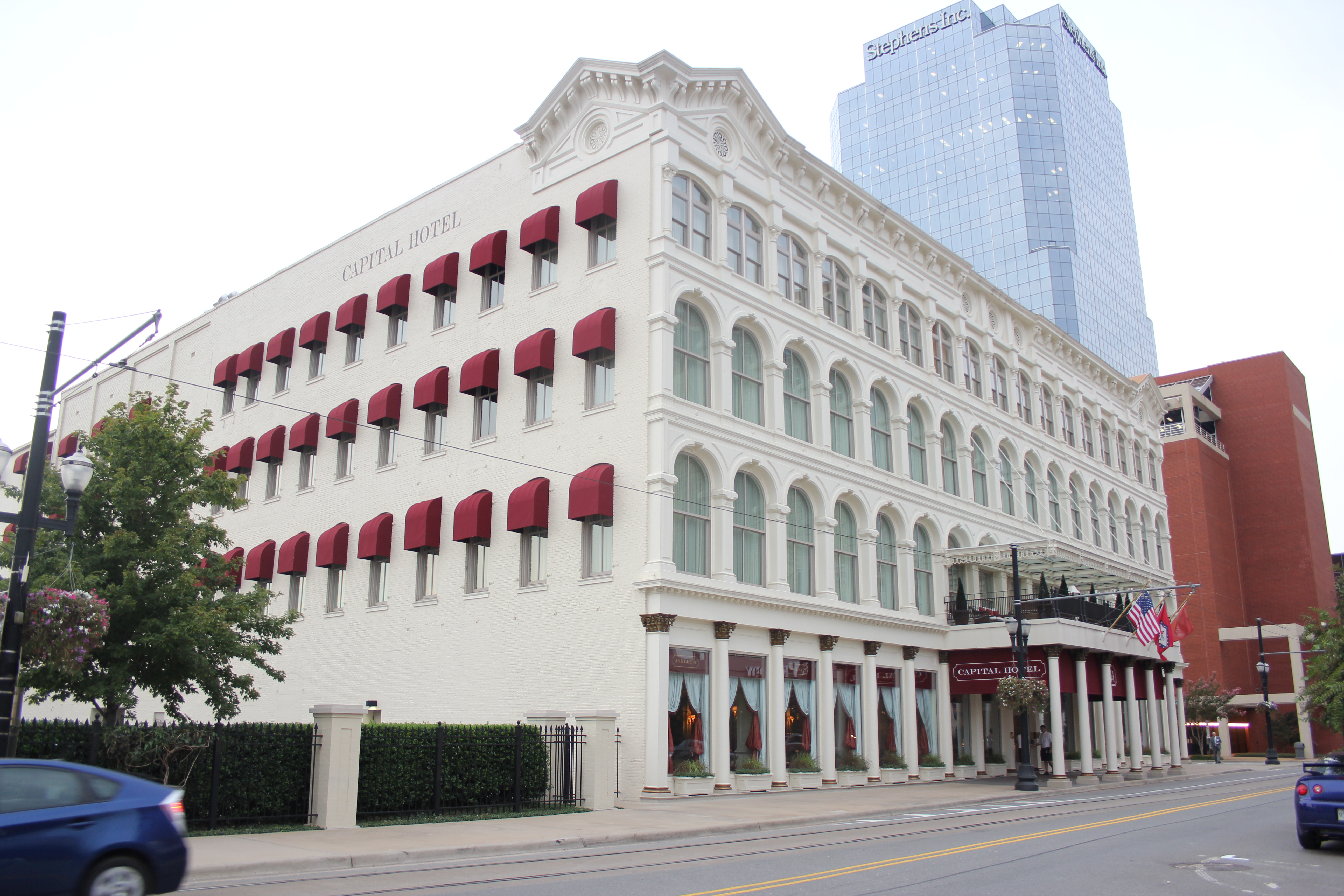
It started in 1872 as the Denckla Block, built on Markham Street for New York railroad financier William P. Denckla. Three stories of brick with a prefabricated cast-iron front shipped to Arkansas in sections via the Arkansas River and bolted on piece by piece. Offices, shops, apartments for businessmen. The Markham Street lot itself had been purchased from Arkansas Supreme Court Justice George C. Watkins, a detail that tells you what tier of money was behind the project.
In December 1876, Little Rock's Metropolitan Hotel burned, and the city was left without a proper hotel. Colonel A. G. DeShon, the Metropolitan's manager, teamed up with Major John Adams and converted the Denckla Block. A local matron named Mrs. Morehead Wright proposed the name. Her reasoning, repeated identically across Encyclopedia of Arkansas and Historic Hotels of America: "a capital enterprise in a capital building in the capital of the state." It opened January 22, 1877.
President Ulysses S. Grant stayed there April 14-15, 1880, traveling Arkansas in the aftermath of the Brooks-Baxter War. His reception was mixed. Arkansas Money & Politics notes that many female spectators turned their backs as he processed through town. There is a famous piece of folklore that the hotel's oversized elevator was sized so Grant could ride a horse to his suite. Encyclopedia of Arkansas says flatly: false. The big elevator (11.5 feet wide, 7.3 feet deep) was added during 1980s renovations, more than a century after Grant slept upstairs.
A fourth floor went on in 1889, with a matching cast-iron facade to preserve the line. In 1908, architect George R. Mann led a $250,000 renovation that introduced the skylight, the mezzanine, and the expanded balcony you see in the lobby today. Most of the postcard-famous architecture is Mann's, not Denckla's.
The Cassinelli sisters, Amelia and Elizabeth, ran the Brass Rail Restaurant and owned the hotel from 1947 to 1977. This was the down era. The building turned into a billiard hall in parts and fell into disrepair. Senator J. William Fulbright, a personal friend of the sisters, ran his first campaign out of an office at the hotel during this period. Amelia died in 1974, Elizabeth sold to Cromwell architecture firm founder Ed Cromwell, and the National Register of Historic Places listing was filed July 30, 1974 by Dianna Kirk.
Cromwell led a three-year restoration that reopened on Christmas Day 1983. Two decades later, Warren and Harriet Stephens funded a second renovation from 2005 to 2007, with a reopening in November 2007. The hotel received a Forbes Travel Guide four-star rating in 2013.
This is where the ghost stories step up. The S.P.I.R.I.T. Seekers writeup notes that paranormal-activity reports increased noticeably after the 2007 reopening. Renovations rattling spirits is a common claim across haunted hotels nationally, almost to the point of cliche, and the Capital Hotel fits the pattern.
The specifics get thinner from there. Haunted Rooms is the only site naming a particular room number, "Room 444," and pinning it with the housekeeping-refuses-to-clean trope, flickering lights, a radio playing music from a station it isn't tuned to, vacuums unplugging mid-use, whispered voices. The same source mentions a staff member who saw a man walk into a fourth-floor bathroom and vanish, big-band music drifting through hallways in the middle of the night, and corridors that stay hazy beyond what the smoking-permitted rooms can account for. Every other lore aggregator just says "upper floors" or "fourth floor." Treat Room 444 as ghost-circuit canon — repeated enough to count as legend, sourced too thin to count as documented.
A note on what you'll see elsewhere on the internet. Several aggregator sites attach a long roster of named ghosts to this hotel — a scaffolding worker named Jefferson, a cigar-smoking businessman, a rose-scented lady in white, a Prohibition-era guard murdered in the basement, Civil War soldier groans, a politician who shot himself, a woman who poisoned herself near the dining room. Every one of those traces back to a single AI-content-farm post and appears nowhere else. They are template ghosts, the same cast you'll find pasted onto a dozen other old hotels by the same content mill. None of them belong to the Capital Hotel.
What belongs to the Capital Hotel is more interesting than the template anyway. A cast-iron front shipped up the Arkansas River in pieces. Grant sleeping there while Arkansas was still bleeding from a constitutional war. A senator running his first campaign out of an upstairs office while sisters in the kitchen kept the building alive. Housekeepers, decades later, declining to give the fourth floor the benefit of the doubt. And a front desk that, when asked about any of the above, declines to comment.
The hotel does not advertise its ghosts. The hotel does not need to.
Researched from 9 verified sources. How we research.