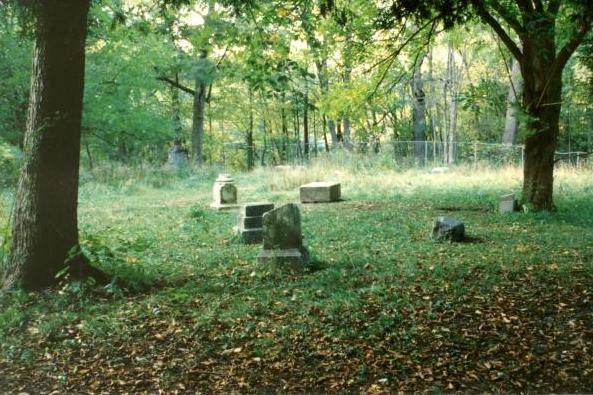
At Bachelor's Grove Cemetery near Midlothian, Illinois, a ghost hunter shot an empty row of broken headstones in 1991. The film came back with a young woman in a faded white dress sitting on one of them, her feet melting into the grass.
At Bachelor's Grove Cemetery, a small abandoned graveyard near Midlothian, Illinois, the most famous thing that ever happened was a photograph of nobody.
On a day in August 1991, a Ghost Research Society member named Mari Huff aimed her camera across a row of broken headstones. She was shooting high-speed black-and-white infrared film, not the ordinary kind. Through the viewfinder she saw an empty cemetery. When the film was developed, one frame held a young woman in an out-of-date white dress, sitting on a checkered grave marker, her legs and feet seeming to dissolve into the grass as she gazed off toward the trees. No living person had been sitting there.
It came to be called the Madonna of Bachelor's Grove. Paranormal researchers say they studied the original negative for decades and found no sign of tampering. Hundreds of people have photographed that same checkered monument since. None of them got her back.
She isn't the first version of her, either. An earlier photo from 1979 shows a figure in a flowing white hood appearing to carry a baby. The 1991 woman carries nothing. Later sightings describe her wandering the north side of the grounds alone, with a lost, melancholic look.
The cemetery had stories long before the camera. The first burial recorded here was Eliza Scott, in November 1844; the last was Robert Shields, in 1989. Then the old Midlothian Turnpike was rerouted to 143rd Street, and the place was left stranded off the road. Teenagers took it over as a party spot. Headstones were toppled, broken, stolen; there were reports of coffins dug up. Today Cook County governs it, and you may enter only between sunrise and sunset.
A local historian, Brad Bettenhausen, has said the tales "have been told and retold by several generations of youths, however, few of these tales have any apparent basis in fact."
Few of them, anyway. The photograph is harder to talk away. It is still a woman who was not there, sitting on a stone, looking at something past the edge of the frame.