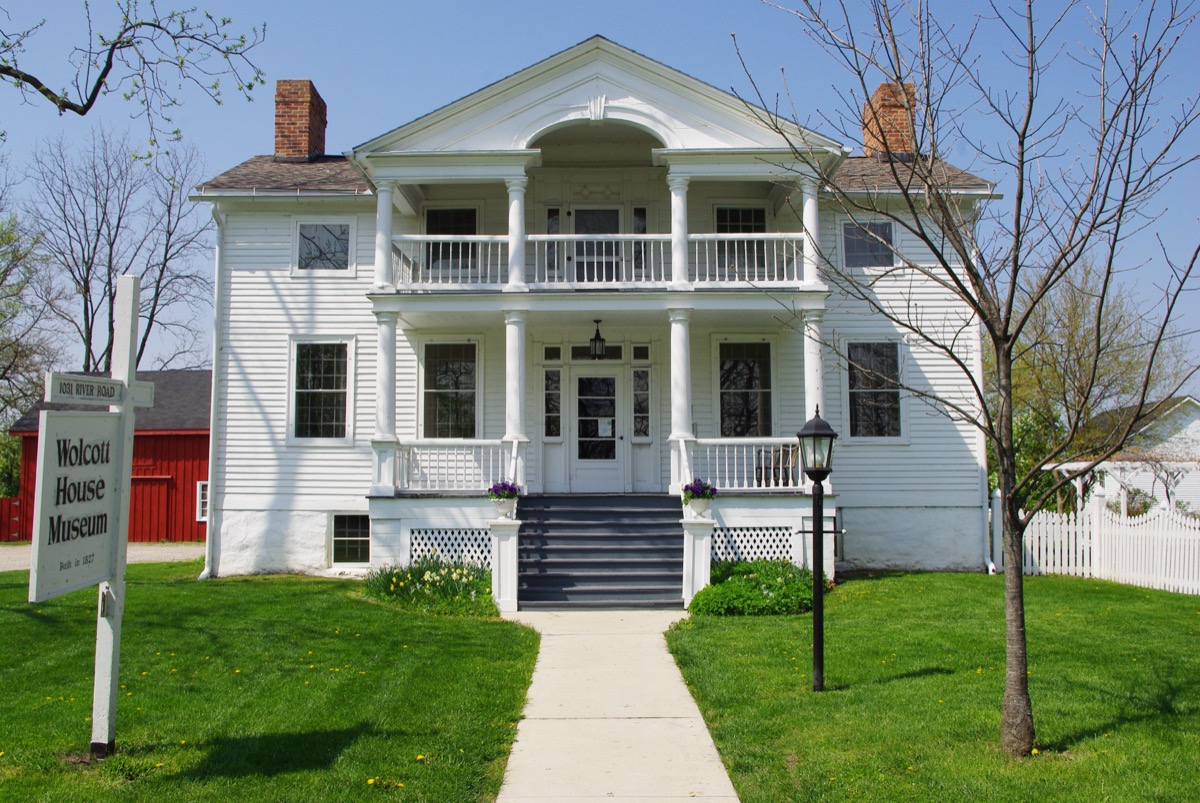
A gentle hand keeps landing on shoulders at the Wolcott House in Maumee, Ohio — upstairs, when people are alone. The merchant who built it married Mary Wells, granddaughter of the Miami war chief Little Turtle. The touch has never had a name.
People keep feeling a hand on their shoulder at the Wolcott House in Maumee, Ohio. It happens upstairs, mostly, and mostly when they're alone — a visitor lingering in a bedroom, a museum worker closing up after hours. They turn to answer the touch and find no one behind them. The after-hours guides have heard it enough times that they raise it themselves now, before a guest can. The hand is gentle every time.
The house it lives in is not a gentle thing. A frontier merchant named James Wolcott raised it on a bluff above the Maumee River, growing a log house he started in 1827 into a 14-room Federal mansion within a decade. He built wharves and warehouses on the river below it and launched two steamships of his own to carry his goods. And he built all of it alongside Mary Wells, whom he married in 1821 — the granddaughter of Little Turtle, the Miami war chief who handed U.S. forces some of their worst defeats in the early 1790s, and the daughter of William Wells, a white boy taken captive and raised Miami who later scouted for the men he had once fought against. Their marriage sat on the exact seam between the Native confederacy that had held this ground and the settlers taking it from them.
Four generations of the family lived in the house until 1957, when the last of them, Rilla Hull, left it to the public on her death. It's a museum now, the centerpiece of a small relocated village — a log house, a one-room schoolhouse, a country church, an old rail depot, all moved onto the grounds around the mansion.
The spirits people describe inside are mostly playful: doors that swing open on their own, objects that turn up where no one set them. The basement is the exception. One visitor wrote that a room there felt as though it were spinning, and that the basement brought on a wave of nausea, totally unexpected.
Upstairs, the activity stays gentle and strange. A medium once stopped at a second-floor bedroom window and said a woman was standing near it — a woman who had died by her own hand, whose remains, she claimed, lay somewhere in the Gulf of Mexico. No name was ever fixed to her. The family record holds no such death, and nothing written down explains the hand on the shoulder.
So there is only the touch itself: light, upstairs, gone the instant you turn, in a house two people built across the line that had just been drawn between them.