Fort Steilacoom Park in Lakewood, Washington is soccer fields, dog trails, and a lake sitting on top of a frontier fort and the asylum that replaced it. A ghost-tour guide walking it at night heard a whole group whistling marching music from an empty field.
Fort Steilacoom Park in Lakewood, Washington is soccer fields, dog trails, and a shallow green lake, and one night a ghost-tour guide walking deep into it heard whistling. Not one person whistling. A group of them, in unison, marching music, coming from past a line of laurel bushes. He had four people with him and all of them heard it. They walked around the bushes and the sound stopped. The field on the other side was empty.
The guide, who gave his name only as Jeff, told that story to a blog in 2012, and he told another one with it. On a different night walk, with two skeptical friends along, he swept a flashlight across the lake and lit up a two-story wooden building: weathered, unpainted, four small openings in it with no glass. When the group reached the spot there was nothing but a large concrete foundation. He checked the next day. The nearest standing structures were barns, roughly three hundred yards off.
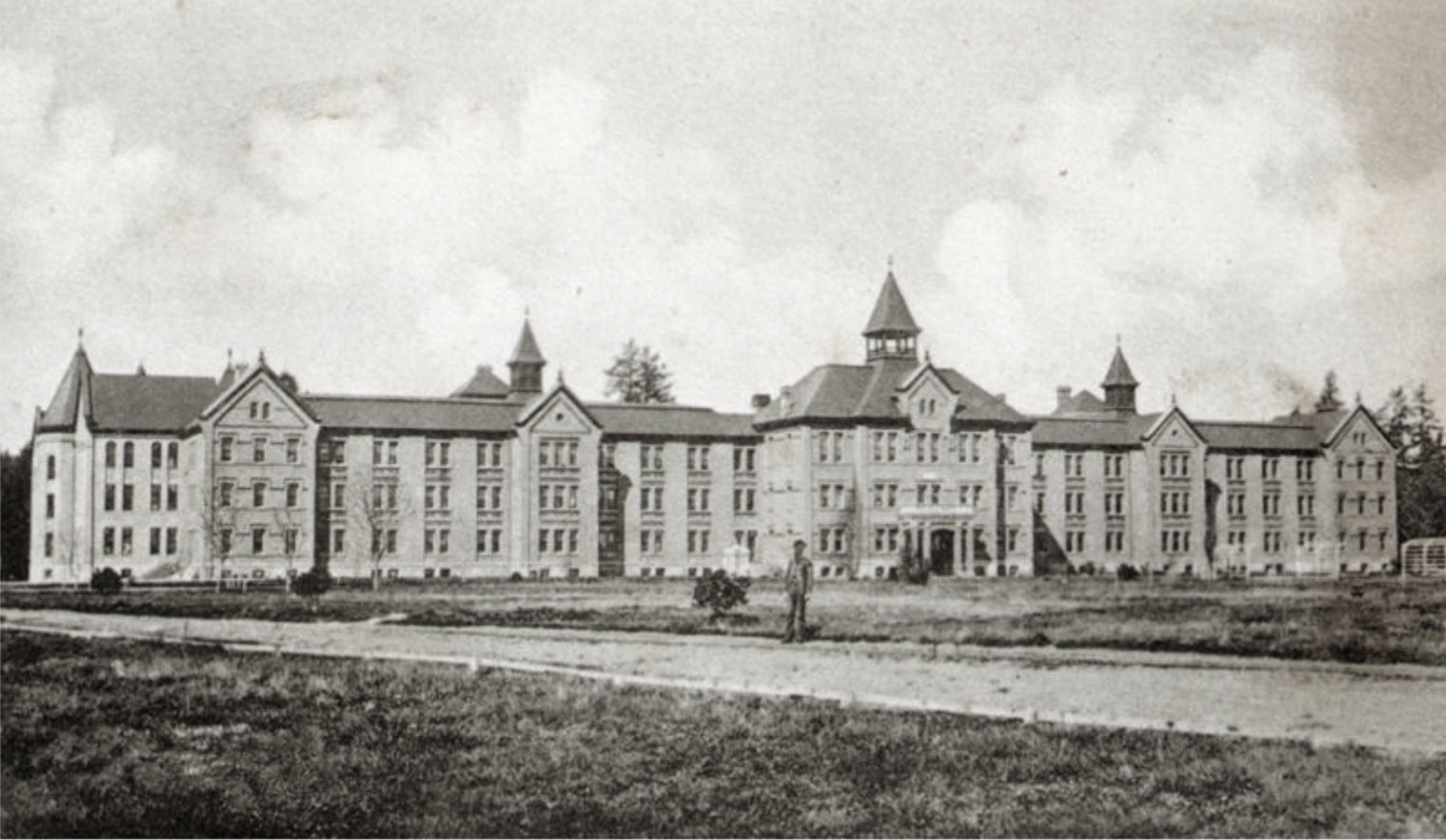
There are foundations all over this park, because the park is two institutions stacked on the same ground. The Army built Fort Steilacoom here in 1849. After the post closed, the Territory took the garrison buildings and in 1871 moved 21 patients into them, 15 men and 6 women, and called it the Insane Asylum of Washington Territory. It became Western State Hospital and it kept going. The patients worked a farm that ran until 1965. They planted the poplars along the lake shore. The soccer fields sit on ground they tilled.
Near one of the parking lots is the cemetery. Between 1876 and 1953, 3,218 people were buried in it, and for 77 years a state practice forbade putting their names on the markers. Each grave got a small numbered block of concrete instead. Seattle Terrors, a ghost-tour company that works the site, says shadow people are seen walking through that graveyard, and that some visitors have heard muffled screaming from under certain graves.
Laurel Lemke worked at Western State for 27 years before she started trying to hand the names back. Her volunteers got a bill through in 2004 that opened the records, then bought stones at $66 apiece. By 2020 they had restored about 1,800 names. Roughly 1,400 people are still numbers. Lemke left the old concrete blocks in the ground beside the new headstones on purpose. "We wanted to keep them there," she said, "to give people an idea of how anonymously they'd been buried."
The lantern tours that walk this ground after dark have a name for their soldier. They call him Archibald, the last man to leave Fort Steilacoom and who still remains in death. No muster roll, roster, or fort history has an Archibald in it. The last garrison out was Battery E, Second Artillery, and it shipped to Alaska.