Sleepy Hollow Cemetery in New York holds a seated bronze woman on a Gilded Age tomb. Local legend says she weeps as you walk up, gives bad dreams if you knock on the door, and sheds tears of blood if you sit in her lap.
At Sleepy Hollow Cemetery in New York, there's a bronze woman seated on a tomb, and the story local teenagers told for decades is that she weeps as you walk toward her. Knock on the mausoleum door behind her and she gives you bad dreams. Sit in her lap and she cries tears of blood. Strike her or insult her, and she curses you.
They call her the Bronze Lady. She marks the mausoleum of Civil War General Samuel Thomas, who died in 1903, and she was cast that same year by a sculptor named Andrew O'Connor, Jr. The general's widow never liked her. She wanted something more cheerful, so O'Connor cast a happier head and brought it to her, and when she approved it he smashed it. "I just made this to show you that I could do it," he said. "I should never let such a monstrosity out of my studio." The mourning figure stayed.
The dare became a local rite through the 1960s, '70s and '80s, something teenagers drove out to test in the dark. One story still passed around has a woman touching the statue's face and finding her car crushed by a falling tree limb two days later. That one's only ever been told, never traced — which is most of what a place like this runs on.
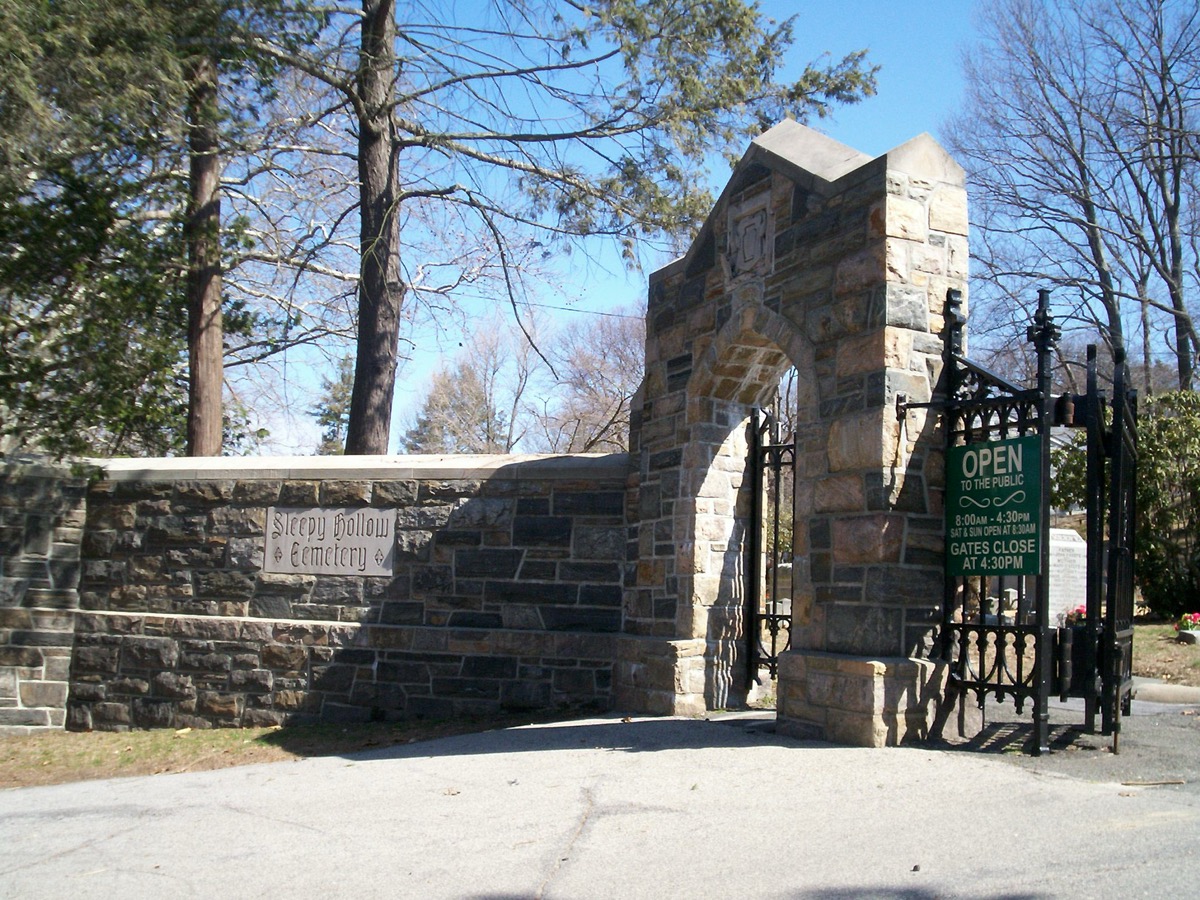
The cemetery itself was incorporated in 1849, a designed garden cemetery laid out on undulating ground above the Hudson River and Pocantico Creek. It holds roughly 47,000 graves across about 90 acres, and the names cut into the bigger monuments read like a Gilded Age ledger: Andrew Carnegie, Walter Chrysler, Samuel Gompers, the Helmsleys. But the oldest dead are next door, in the three-acre churchyard around the Old Dutch Church, where the earliest legible stone reads 1755 and burials may go back before 1650.
That churchyard is the haunted one in the popular imagination, and the reason is Washington Irving. He helped found the cemetery and pushed for its name, and he's buried here near the church he made famous. In 1820 he set "The Legend of Sleepy Hollow" against that old Dutch ground, building his Headless Horseman onto folklore that was already there — the tale of a Hessian soldier decapitated by a cannonball in the Revolution. No record confirms any such body was buried in the churchyard at all.
So the most-told ghost on these grounds isn't the Horseman, and it isn't anyone Irving wrote. It's a statue a widow tried to replace, cast by a man who broke the kinder version with his own hands, still weeping, the story goes, for whoever walks up close.