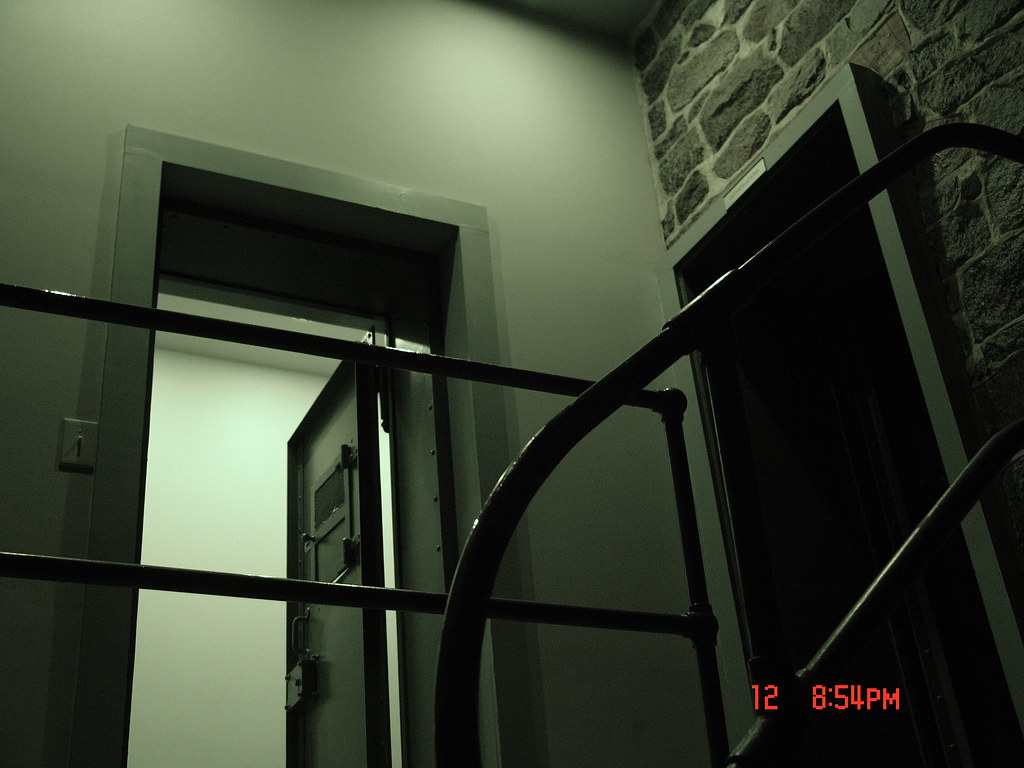
The old gray-granite jail in Princess Anne, Maryland — locals call it the Grey Eagle — keeps a child's face in an upstairs window where there's no floor to stand on. The building was the site of Maryland's last recorded lynching, and the people who work inside say it never emptied out.
At the old jail in Princess Anne, Maryland, a guest on a ghost walk named Desiree Wallace photographed the building, blew the image up later, and found a face looking back. A small boy, by the description — "the outline of a hairline, eyebrows, a nose, cheeks a mouth" — sitting in the lower center pane of the center window.
The window has no floor behind it. The second story opens straight down to the first, with only a steel staircase below, so no living person could have stood where the face appears. "There's no possible way anyone could have been standing in that window," the tour operator who runs the walk has said. The face turned up only later, when the picture was enlarged.
The jail is a gray granite structure the locals call the Grey Eagle, built as a fireproof fortress after prisoners burned an earlier jail on the same site. By the traceable accounts the granite went up around the turn of the 20th century, though no architectural record was reachable to pin the exact year. What the record does hold is the night of October 18, 1933. About 25 officers were inside, guarding a Black laborer named George Armwood, 22, who had an intellectual disability. A crowd had gathered outside and grown into the thousands. When the police ran out of tear gas, the mob used two fifteen-foot timbers as battering rams to break through the doors.
They found Armwood hiding under his mattress. They dragged him down the steel stairway, cut off an ear, and hanged and burned him. Two years later a grand jury heard 42 witnesses and declined to indict anyone. It was Maryland's last recorded lynching, and not the only killing tied to the building — a man named William Andrews was hanged from a walnut tree near here in 1897.
The jail was restored rather than torn down and became the Princess Anne Police Department. During the renovation, construction workers reported windows opening and closing on their own, footsteps, and tools thrown across rooms, at a concentration that left them refusing to work alone or after dark. Police and dispatchers since have described televisions switching on by themselves and phantom voices surfacing on suspect-interview recordings that no one heard in the room. One dispatcher working alone brought her children in; her son went upstairs and came back shaken, saying he'd seen a lady who was sick. No one else was in the building.