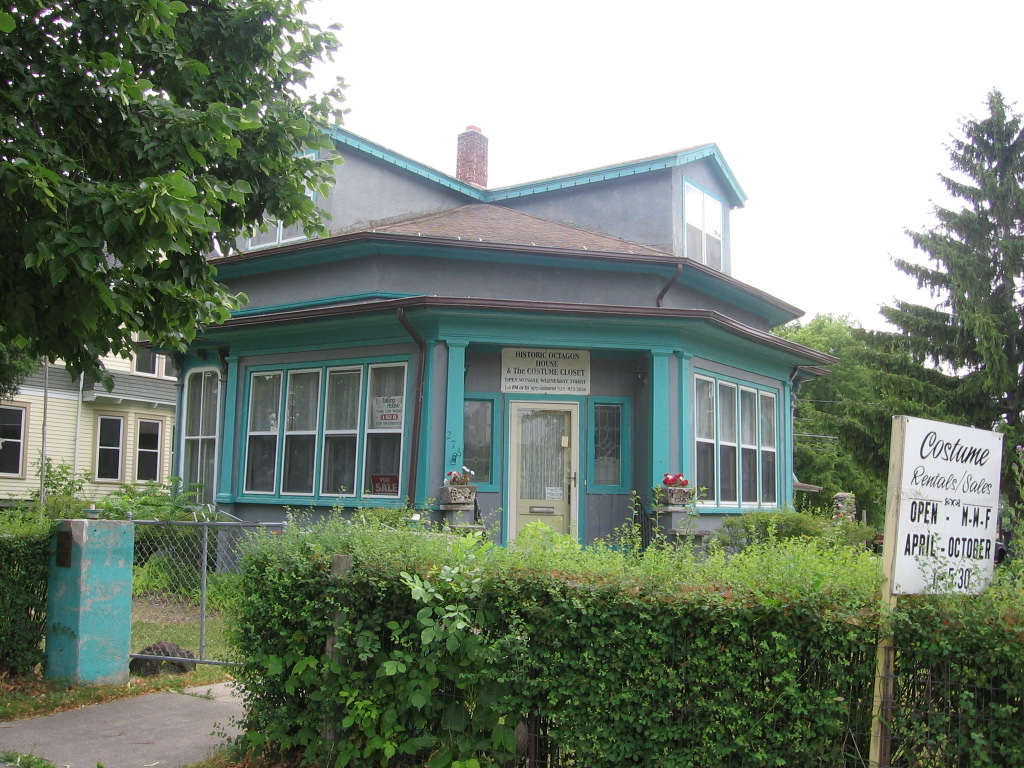
Built in 1856 with nine secret passageways by Fond du Lac's first mayor, this octagonal house is haunted by Ruth Pier Brown, whose husband Edwin died at the Battle of Antietam in 1862, and by the sounds of their three children playing on the upper floors more than 150 years later.
Marlene Hansen was hanging wallpaper in the upstairs bedroom when she turned and saw a woman leaning in the doorframe, watching her work. The figure was transparent. Hansen recognized her from old family photographs: Ruth Pier Brown, who'd been dead for over a century.
Hansen bought the Octagon House at 276 Linden Street in 1975 without ever seeing the inside. A former circus trapeze artist, dancer, and costume maker turned antiques dealer, she spent the next four decades restoring the place and opening it for tours. She also spent those decades living alongside whatever was already there. "I regard Octagon House as being possessed by the spirit world," Hansen told interviewers. She wasn't being dramatic. She meant it as a fact of residency.
Isaac Brown built the house in 1856. He was Fond du Lac's first mayor, a carpenter and fur trader who'd grown increasingly afraid of attacks from the Native Americans living across the river. So he built a house designed for hiding. The octagonal structure, following Orson Fowler's architectural plans, contained nine secret passageways and spaces: a hidden stairway behind a false fireplace in the parlor that led to a basement tunnel running toward the river, a storage room concealed beneath the front porch, crawl spaces tucked behind fake drawer panels in an upstairs bedroom. Someone scratched a message into one of the hidden walls, believed to date from 1888, hinting at clandestine gatherings. Nobody knows who wrote it.
Brown gave the house to his son Edwin as a wedding gift. Edwin and his wife Ruth raised three children there: Louis, Edward, and Hattie. Then the Civil War came. Edwin left for the Union Army and never came back. He died on September 17, 1862, at the Battle of Antietam, the single bloodiest day in American military history. He's buried in Rienzi Cemetery.
Hansen believed Ruth and the children never came to terms with that loss, that the grief kept them tied to the house. Visitors report hearing children laughing and playing on the upper floors, more than 150 years after Louis, Edward, and Hattie lived there. Cold, invisible hands touch people on the arms and shoulders. At least one visitor has been shoved down the stairs by something they couldn't see.
A spinning wheel in the house was taken completely apart in a matter of seconds, with no one near it. Doors open and close on their own. A ghostly young boy has been spotted in multiple rooms. And then there's Ruth, who shows up as a full figure, sometimes in doorways, sometimes near windows, always watching.
The Southern Wisconsin Paranormal Research Group investigated the house in 2005 and confirmed they found evidence of activity. Hansen, who'd been witnessing it for 30 years by then, wasn't surprised. "I can't tell what others have seen, felt, or experienced," she said, "but I can tell that they do experience something. Their body language changes and I can see it in their faces."
Local lore has tried to attach other stories to the tunnels. During Prohibition, Fond du Lac earned the nickname "Little Chicago" for its bootlegging activity, and some academics believe the secret spaces were used to store and transport liquor. Others have suggested the tunnels served as a stop on the Underground Railroad, though historians have disputed that claim. The house was listed on the National Register of Historic Places in 1972, nearly demolished to make room for a high school, and saved by Hansen's impulsive purchase.
The house at 276 Linden Street carries too much history for one explanation. A father who built rooms for hiding. A son who never came home from war. A wife who waited, and who might be waiting there now.