The Kings Park Psychiatric Center on Long Island closed in 1996 and was left to rot. Trespassers who slip into the buildings report banging, slamming doors, and figures in the dark. In 1954 the place held 9,303 patients it was never built for.
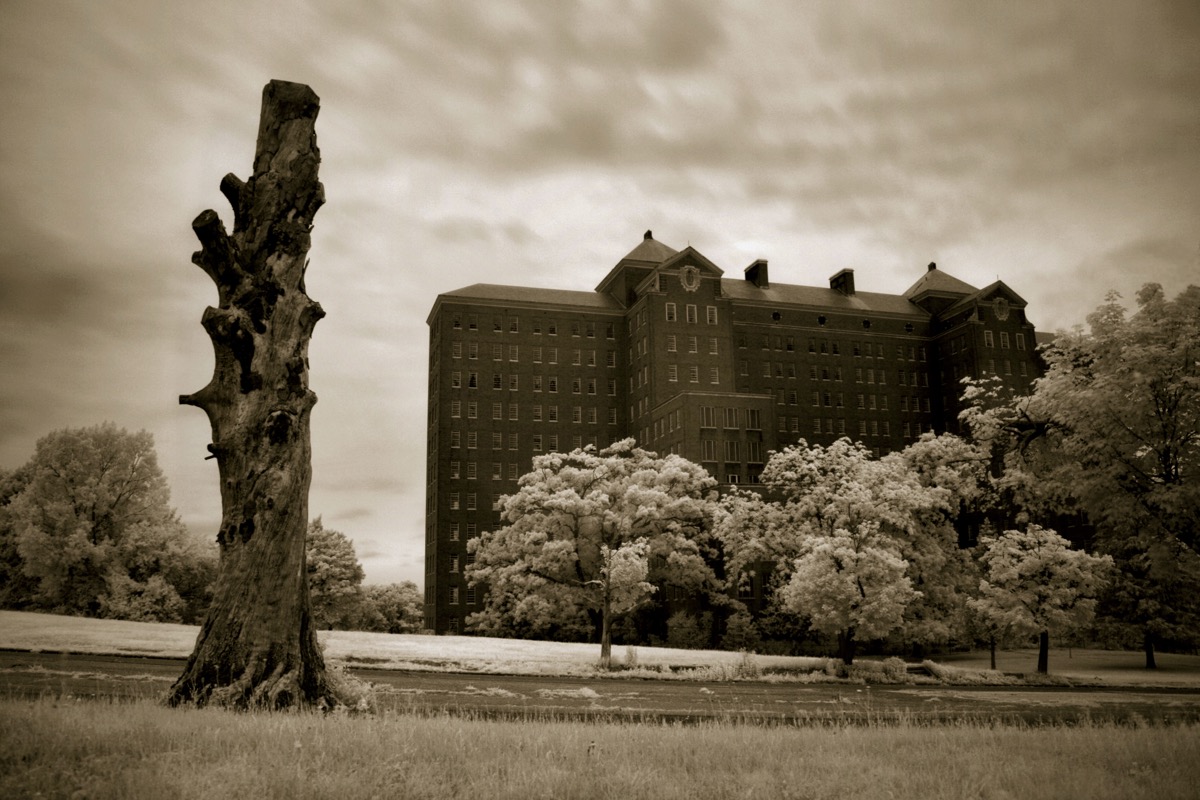
At the abandoned Kings Park Psychiatric Center on Long Island, the people who slip past the fences report the same things: banging through the empty buildings, doors that slam, figures standing in the dark. Most of it centers on Building 93, a 13-story tower that looms over a sea of suburban split-levels, condemned and waiting.
It didn't begin as a place of horror. Kings County opened it in 1885 as a rural "farm colony," a gentle idea: the mentally ill from Brooklyn's crowded asylums would heal out here through fresh air and fieldwork, feeding livestock and growing their own food. The state took it over in 1895. For a while it really was a self-contained village, with its own power plants, fire stations, staff housing, piggeries, and cow barns. A railroad spur ran supplies and passengers straight onto the grounds, and underground steam tunnels connected building to building, used to move patients, supplies, and laundry out of the weather.
Then it filled up. By 1954 the census hit 9,303 patients on a campus built for a fraction of that. Before Thorazine arrived in 1955, treatment meant prefrontal lobotomies and electroshock. The farm colony had become a warehouse.
Building 93 went up in 1939, neoclassical and WPA-funded, an infirmary for the geriatric and the chronically ill. Lower floors held ambulatory patients in large day rooms; the upper floors confined the infirm. The state closed the whole center in the fall of 1996 and walked away. The buildings still stand, lined with asbestos, floors collapsed inside, elevator shafts open to the dark.
People keep going in anyway. One visitor, Laura Leita, described "an immensely loud banging" in Building 93, "like someone was trying to take the building down." Volunteers later traced it to air moving through old roof drain pipes. She also photographed a dark form in an upper corner that seemed to follow her camera across several shots.
The town historian, Steve Weber, worked at the hospital for years. "Never have I ever seen anything that would indicate that it is haunted," he says. The police, for their part, worry less about ghosts than about the building itself. "Inside the buildings you have asbestos, you have deterioration, floors that have collapsed, open elevator shafts," one sergeant told a TV crew, explaining why they ticket trespassers, especially around Halloween.
Most of the campus is something gentler now. Around 90% of the grounds reopened as Nissequogue River State Park, and the old railroad spur is a hike-bike trail. But Building 93 was never cleared. It still looms over the park, fenced and condemned, holding whatever filled those wards: thousands of people, suffering at once, in a tower that was never meant to hold them.