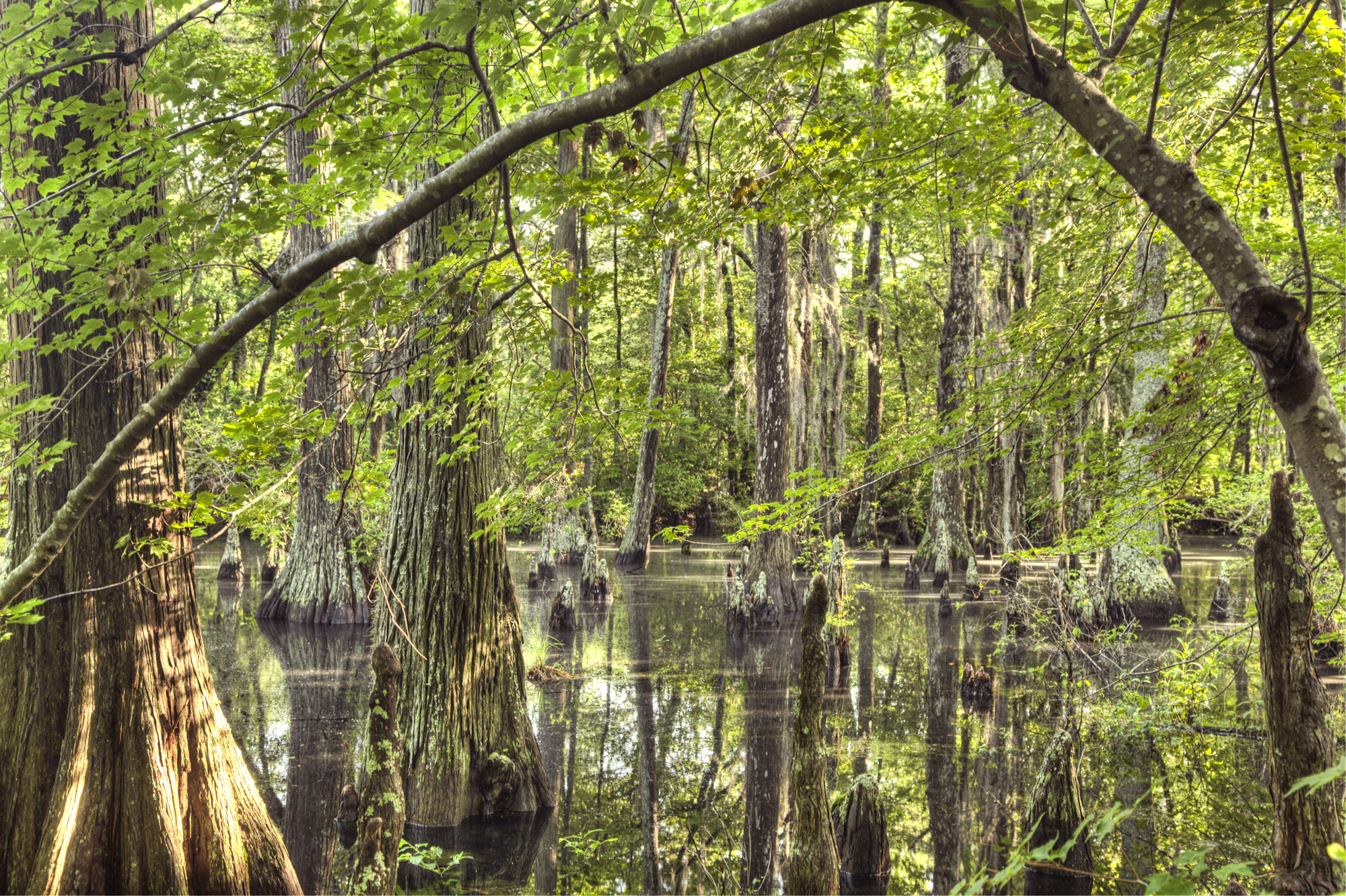
First Landing State Park sits on the Cape Henry beach where 1607 colonists landed and where 64 Chesapeake people were reburied 390 years later, to the day.
On April 26, 1607, English colonists waded ashore at Cape Henry and got jumped by Chesapeake warriors before sundown. On April 26, 1997, exactly 390 years later, archaeologists reburied 64 sets of Chesapeake remains in a 20-foot circle of sand a few hundred yards inland from that same beach.
Same date. Same stretch of coast. Two centuries of distance collapsed into one calendar day.
That symmetry is the reason this park has weight. Most haunted state parks lean on a single ghost story. First Landing has a 390-year span between two specific, dated, documentable events at the same patch of sand, and the ghosts come second.
Start with the 1607 attack, because colonist George Percy wrote it down. A 30-man shore party walked the dunes, and Chesapeake warriors came at them "creeping on all foure, from the Hills like Beares, with their Bowes in their mouthes." They wounded Captain Gabriel Archer in both hands and a sailor in two places "very dangerous," then "retired into the Woods" once Newport's men opened fire. First violent contact between Virginia's colonists and the people already living there. Day one. Hours after the boats landed.
Captain Christopher Newport's three ships, the Susan Constant, Godspeed, and Discovery, continued up the James to found Jamestown a few weeks later. The Chesapeake stayed where they'd always been, in the Great Neck area near the landing site. By the end of the 17th century, the tribe had ceased to exist.
Skip forward to the 1970s and 1980s. Virginia Beach builds out. Bulldozers turning over sandy soil for subdivisions and shopping plazas surface bone after bone. Archaeologists collect the remains of 64 Chesapeake people, ranging from roughly 800 B.C. to 1600 A.D., and ship them to Richmond. The Virginia Department of Historic Resources keeps them on shelves for nearly two decades.
In 1997 the state gives them back. Oliver Perry, Nansemond Chief Emeritus, leads the reburial ceremony on behalf of the eight recognized Virginia tribes. They pick April 26 deliberately. Same calendar day as the 1607 landing. Same beach.
"If you stop and think in terms of people who died overseas," Perry told the Virginian-Pilot, "they are returned home and given a dignified, respectful burial."
The circle itself is small. Roughly 20 feet across, a sandy clearing shaded by pines and oaks and hollies, just off a parking lot. No big sign. Not marketed as a haunted destination. You can drive past it without noticing.
Visitor accounts describe drumming and chanting near the circle at night, and shadowed figures moving through the surrounding woods. None of it is anchored to a named witness or a dated incident. It's an ambient story that lives on ghost-tour itineraries and travel listicles. Take it as atmosphere, not evidence. The verifiable layer here is the burial and the date.
Blackbeard adds a second layer to the same dunes.
Edward Teach worked the Cape Henry coast in the early 1700s. According to Lynnhaven River NOW, his crews stationed two or three lookouts on a tall sand dune nicknamed "Pirate's Hill" to scan the bay's entrance for merchant ships rounding the cape. Pleasure House Road and Lookout Road still exist in Virginia Beach, toponymic echoes of that pirate infrastructure, though Lynnhaven River NOW is honest that this layer "appears in local folklore rather than documented historical records."
The documented part: Blackbeard was killed November 22, 1718, at Ocracoke Inlet by Lieutenant Robert Maynard, who beheaded him and hung the head from his bowsprit. Per Colonial Williamsburg, the head was later displayed on a pole at the entrance to Chesapeake Bay as a warning to other pirates. So Blackbeard's head was, briefly, an installation looking out over the same water First Landing now fronts.
The treasure legend follows. Visit Virginia Beach documents the story: Blackbeard's crew supposedly buried plunder in these dunes before fleeing through the inland waterways, and the cache has never been found. The same tourism page notes visitor accounts of "fleeting glimpses of a headless figure" wandering the dunes, mysterious footprints in the sand, sudden cold breezes. The folklore says prospectors once brought heavy excavation equipment to dig for the cache, and Blackbeard's ghost ran them off every time. No documented prospector account exists. It's campfire material with a real coastline.
A note on the park itself: 2,888 acres, 1.5 miles of Chesapeake Bay beach, 19-plus miles of trails. It's Virginia's most-visited state park, drawing over a million people a year. The Bald Cypress Trail is the one to walk, a 1.5-mile boardwalk loop through standing cypress swamp behind the trail center at 2500 Shore Drive. Knee-deep tannic water, ancient knobby cypress knees breaking the surface. Designated a National Natural Landmark in 1965 for being the northernmost place on the East Coast where subtropical and temperate plants grow together.
Built by African-American Civilian Conservation Corps crews and dedicated June 15, 1936, the park was called Seashore State Park until the 1997 rename. It was closed from 1955 to 1965 rather than integrate, and reopened only after the Civil Rights Act. That's a real haunting too, and worth knowing as you walk in.
What you should actually do: drive to the burial circle. Stand at the edge of it. Twenty feet of sand, shaded, no plaque selling you anything. The remains underfoot are older than the Pyramids on the early end and went into the ground on the same April day, 390 years apart from the colonists who landed a short walk away.
That's what's here. The ghosts are footnotes.