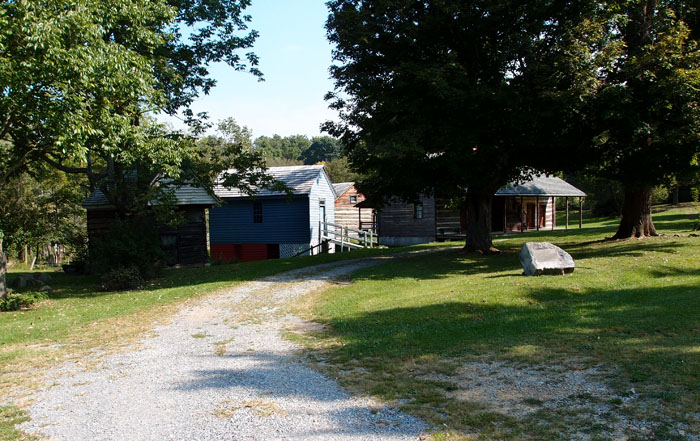
Amanda Ellen Steadman — Aunt El — spent her life weaving and quilting inside a log house called Roseland. In the 1990s the house was sawed into three pieces and hauled to Exchange Place, a living history farm in Kingsport, Tennessee. Volunteers say the ghost came with the logs.
After Amanda Ellen Steadman died in 1939, her family kept one of her quilts on a bed in Roseland, the log house where she'd spent nearly her whole life. It would not stay there. They'd smooth it down at night and find it thrown off by morning, and after enough mornings they stopped trying to explain it. They just called her Aunt El, the way they always had, and let her keep her quilt.
She was a weaver and a quilter, born in 1860, gentle and devoted to children though she never had any of her own. Roseland took its name from the rose gardens that once ringed it: a triple-log-pen cabin whose oldest room dates to the late 1700s, passed down through the Bachman, Steadman, and Shipp families. Aunt El lived and died inside it.
Then, in the 1990s, the house left.
Roseland was donated to Exchange Place, a living history farm out on Orebank Road in Kingsport, Tennessee. To move it, a crew sawed the whole log structure into three pieces, hauled it off its lot on Shipp Street, and reassembled it on the farm, chinking and gingerbread porch and all. The foundation stayed behind. So did the grave: Aunt El is buried in the family cemetery on a ridge that looks down over the bare lot where her house used to stand.
The activity did not stay behind.
Volunteers at Exchange Place report the attic lights burning after dark. Doors ease shut on their own. The farm's own literature doesn't dodge it. It calls Aunt El "a comforting, albeit sometimes mischievous, companion," a ghost the place seems to have inherited along with the logs. The paranormal podcast Homespun Haints, whose hosts were shown around by one of Aunt El's own descendants, put it flatly: "People see the apparition of Aunt El, previous resident of the house."
The house she lived in is gone from Shipp Street now, cut apart and carried away years after she died. What the volunteers keep meeting is a reassembly: the same logs stacked on a foundation Aunt El never knew, on a farm she never set foot on in life.
Roseland today is the meeting hall of the Overmountain Weaver's Guild. A weaver's ghost, in a room full of looms, carried beam by beam to a farm she had no reason to haunt in life. Her grave stayed on the ridge back home, miles off, above an empty lot. Whatever the volunteers meet in the attic went with the wood.