Boggy Creek

Boggy Creek

👻 other

Fouke, Arkansas

TLDR

Fouke, Arkansas, May 1971: a seven-foot creature with red eyes grabs Bobby Ford, and a $160,000 movie makes Boggy Creek legend.

The Full Story

Bobby Ford ran through his own front door without opening it. He didn't stop to turn the knob. He hit the wood at a full sprint, splintered it, and kept going. On the other side, he told the Miller County constable, a seven-foot thing with brown hair and eyes "about the size of a half dollar and real red" had reached for him out of the dark.

That was the night of May 1-2, 1971, on Rural Route 1 about ten miles south of Texarkana, off U.S. Highway 71 near Fouke. Sources disagree on whether it was the Saturday night or the early Sunday hours, so the Saturday-into-Sunday window covers all of them. Ford was 25. His wife Elizabeth saw a hairy arm with claws coming in through the window. Bobby and his brother-in-law Don chased the thing into the swamp. Investigators came back to the house and found three-toed footprints in the dirt and claw scratches on the porch. They emptied multiple shotguns into the trees and never found a drop of blood.

Two days later, on Monday May 3, 1971, a staff writer at the Texarkana Gazette named Jim Powell ran the story under the headline "Hairy 'monster' hunted in Fouke sector." The Associated Press picked it up. So did UPI. By the end of summer, hunters from Texas were combing the Sulphur River bottoms with shotguns, and a local ad-salesman at a Texarkana agency named Charles B. Pierce was sketching out the docudrama that would make him famous.

You can argue about whether the creature is real. You can't really argue about what happened next.

Pierce borrowed $160,000 from a local trucking company. He cast Fouke residents as themselves. Smokey Crabtree, a wildlife guide, played a wildlife guide. So did his son Travis. So did Willie E. Smith. Earl E. Smith wrote the screenplay. Howco International Pictures put it on the drive-in circuit on August 23, 1972. "The Legend of Boggy Creek" grossed over $20 million. (Pierce's daughter has claimed $25 million, but that figure cannot be verified, so the safer number is the $20-plus the Encyclopedia of Arkansas cites.) Either way, on a $160,000 budget, with no Hollywood training and no studio, an ad-salesman from Texarkana turned a southwest-Arkansas swamp into one of the most profitable independent films of the decade.

The sightings didn't stop with the Fords. On May 23, 1971, three people, D. C. Woods Jr., Wilma Woods, and Mrs. R. H. Sedgass, said an ape-like creature crossed U.S. 71 in front of their car in broad daylight. In mid-June, somebody walking through a soybean field outside town found tracks 13.5 inches long and 4.5 inches wide, with three toes. Frank Schambach, an archaeologist at Southern State College (now Southern Arkansas University), looked at them and gave the cleanest debunk on the record: "There is a 99 percent chance the tracks are a hoax." His reasoning was geometry. All primates, including hominids, have five toes. This one had three.

The story is older than 1971. Encyclopedia of Arkansas traces sightings in the area back to at least 1946, when a resident near Jonesville reported a creature to Miller County Sheriff Leslie Greer. The Crabtree family has claimed sightings going back further still, including a much-repeated story about Smokey's son Lynn firing three shotgun blasts at a reddish-haired creature while squirrel hunting as a teenager. That account comes mostly through Smokey Crabtree's 1974 self-published book and Pierce's film, both Crabtree-adjacent sources, so it's worth knowing where it comes from before you repeat it.

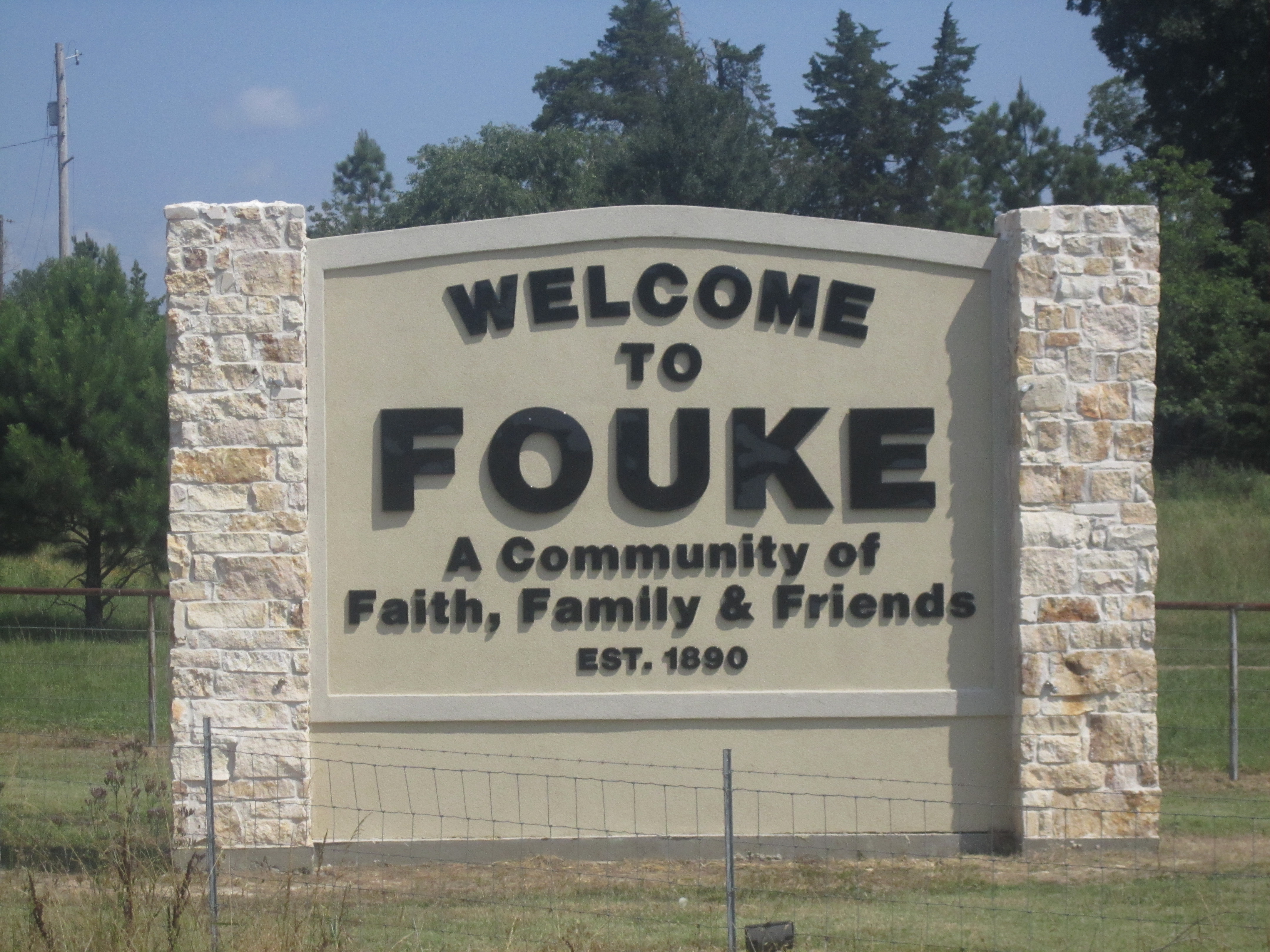
What's not in dispute is the cultural footprint. Drive into Fouke today and the first thing you see is a fiberglass monster head with its arms out on the roof of a building at 104 US-71. The building is the Monster Mart, founded in the early 1990s by Denny Roberts, then president of the local Chamber of Commerce. Local artist Le'Roy Simmons built the fiberglass head. The eyes glow red at night. Inside, the Mart doubles as the Fouke Monster Museum: original news clippings on the walls, vials of Boggy Creek water for sale next to the mugs and magnets, and plaster casts of footprints, including the 14-inch Beanfield Track from the 1971 soybean-field sighting. Roadside America has been writing it up since the days when Roadside America was the only place to find this kind of thing on the open web.

Boggy Creek itself is two miles south of the Monster Mart. It's a tributary of the Sulphur River, and the surrounding country is bottomland hardwood and cypress swamp. Visibility drops to fifty feet inside the treeline, and the sound of something heavy moving through standing water carries a long way.

The Fouke Monster Festival is an annual October event that's been running since 2013, when it was rebranded from the older Boggy Creek Festival. The 2019 edition raised more than $3,000 for the Fouke School District. Smokey Crabtree's "Smokey and the Fouke Monster: A True Story" is still out there, ISBN 0-9701632-0-7, disputing the way Pierce treated some of the locals' accounts. Reba Killian, in a 50-year retrospective on Little Rock's THV11, said of her own childhood sighting: "It could have snapped us like a twig if it wanted to."

The Fouke Monster has no body, no photograph, no DNA, no skeleton. After fifty-plus years of looking, the absence is the point. What survives instead is Bobby Ford's busted front door, an ad-salesman's $20 million movie, a fiberglass head with red eyes, and the Beanfield Track in a glass case at 104 US-71.

Researched from 7 verified sources. How we research.