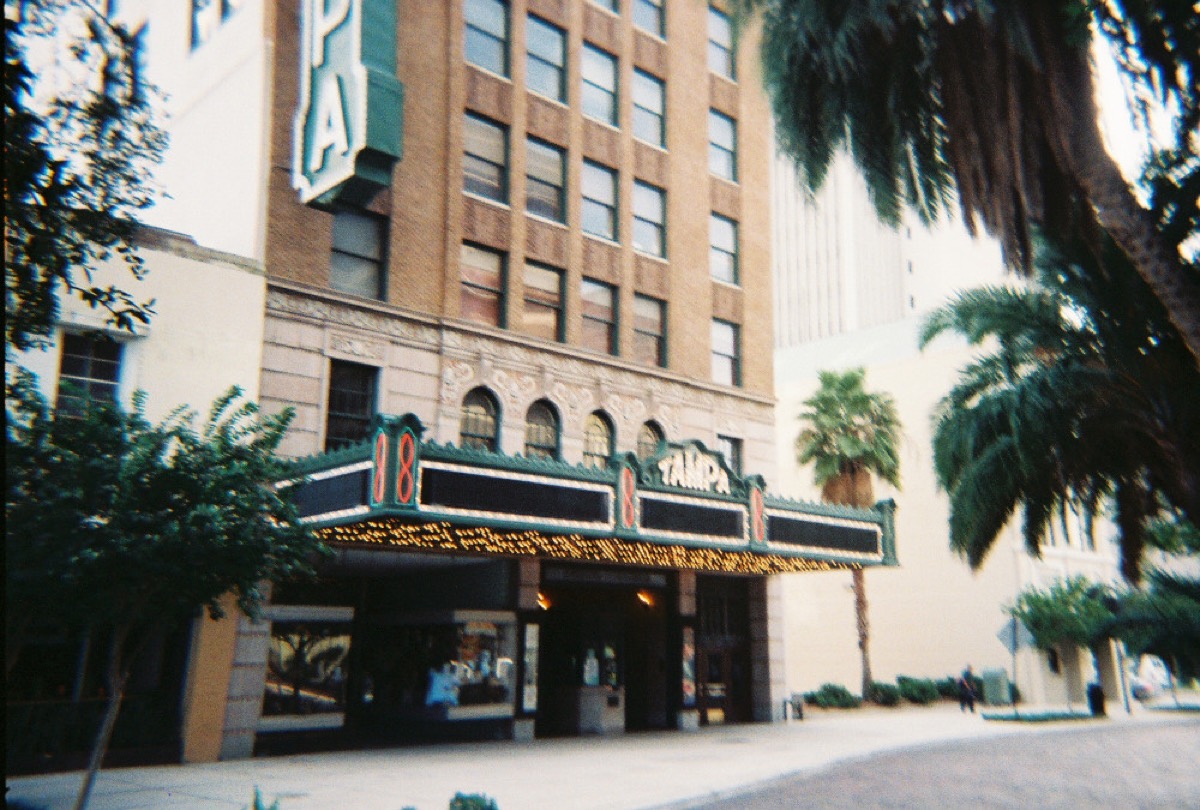
At the Tampa Theatre in Florida, a head projectionist named Foster "Fink" Finley ran the booth for 35 years and, the staff say, never left it. Four projectionists across five decades report the same door, the same shoulder tap, the same lilac aftershave.
The projection booth at the Tampa Theatre in Florida still feels like someone is working it. Four projectionists across five decades describe the same things up there: a door that opens and shuts on its own, the sense of being watched at the exact second they switch reels, and now and then a tap on the shoulder, as if someone has leaned in to ask whether they need a hand. They all point to the same man.
His name was Foster Finley, and everyone called him Fink. He ran the booth from 1930 to 1965, thirty-five years, and he ran it like a man who had nowhere better to be. He'd arrive by 8 a.m. for films that didn't start until noon, climb the steep stairs with coffee and a cigarette, shave in the booth's little bathroom, and change into a three-piece suit before the first reel. When lung cancer caught up with him, he kept working until he collapsed up there. His co-projectionist, Bill Hunt, carried him home. He died a few weeks later.
The theatre opened in 1926 as a John Eberson "atmospheric" house, the ceiling rigged with artificial twinkling stars over a fake Mediterranean courtyard. It was slated for demolition in 1973 and saved by a citizen campaign. Through all of it, the booth kept its tenant.
Staff and patrons report his particular signatures — coffee, cigarettes, the lilac aftershave he wore — drifting through the balcony rows nearest the projection room. One projectionist, Caitlyn, couldn't open the booth door minutes before a film, though it has no lock. Her boss confirmed it over the phone: "Caitlyn, there's no lock on that door."
The reel-changeover was the high-pressure moment of Fink's old job, the beat where one slip ruined the show. It's the exact moment, the projectionists say, that they feel the hand on their shoulder.