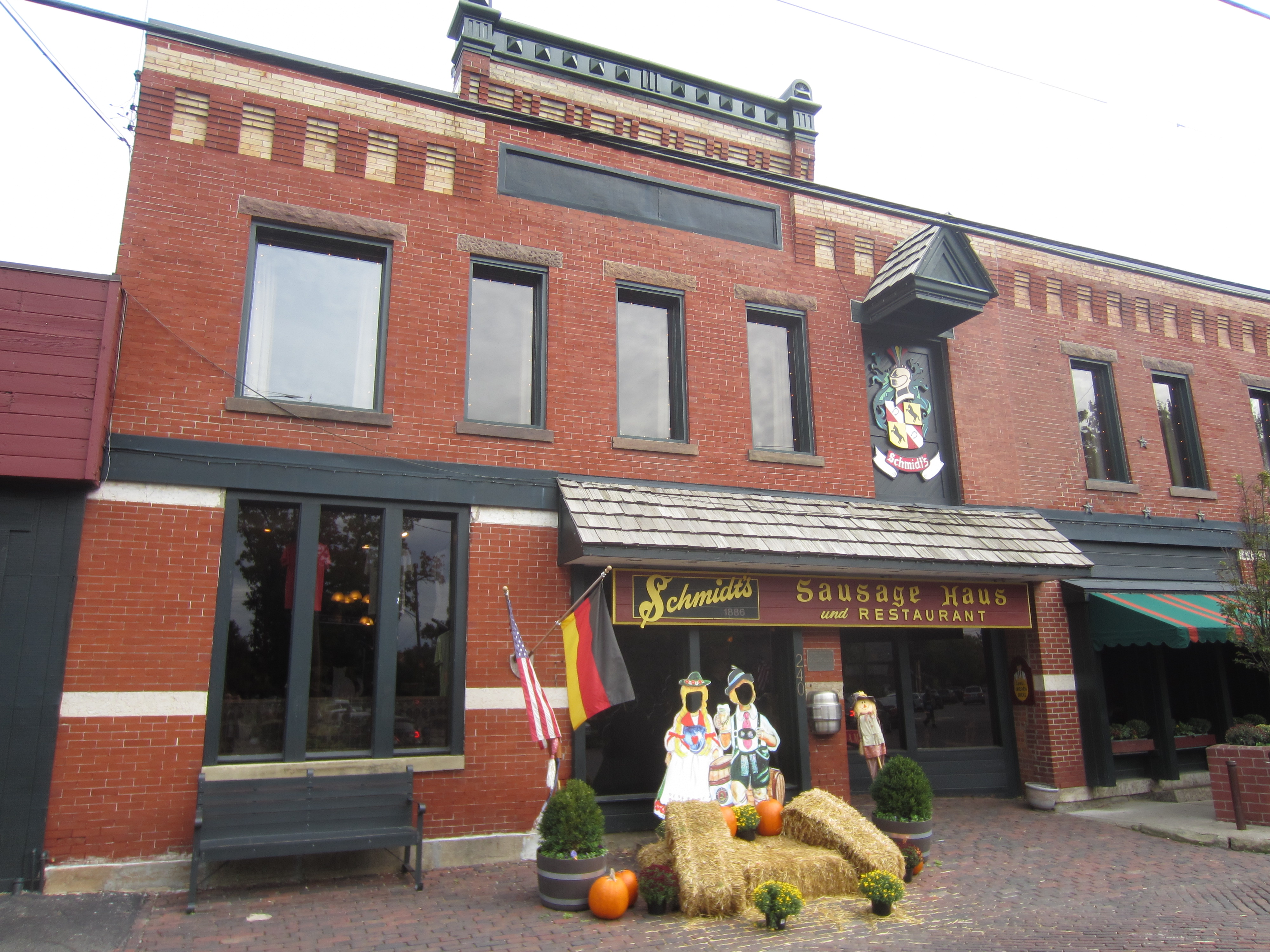
Schmidt's Sausage Haus has anchored Columbus's German Village since 1886. Staff call their friendly ghost Grandpa and figure he's the founder, J. Fred Schmidt, who waves from the upstairs mirror and once left four chairs circled in an empty room.
At Schmidt's Sausage Haus in the German Village neighborhood of Columbus, Ohio, a cleaning crew was finishing up one night after the doors were locked when a clatter rang out from the floor above them. Three of them went up. In the larger of the two upstairs banquet rooms, dark and empty, four chairs had been pulled into the center and turned so their backs touched, a tight circle facing inward, set for a conversation among people who weren't there.
Then one of the crew glanced at the big mirror on the north wall and saw an elderly man in it, smiling, waving at him. He turned around. Nobody. "No, but I feel like someone's watching me," another worker said, "and I think we ought to get out of here."
The staff call him Grandpa. They figure he's J. Fred Schmidt, the German immigrant who started the family meatpacking house in German Village in 1886, five generations back. The restaurant itself didn't open until July 1967, but the Schmidts go much further back here, and they've decided the friendly old man in the mirror is the one who began it all.
He turns up in smaller ways too. The Ohio Exploration Society reports footsteps crossing the empty second floor. Staff describe lights switching on and off on their own, and the sense of people moving quickly past them through the dining room, watching, now and then brushing an arm.
None of which fits the room you'd walk into. Schmidt's is one of the warmer stops in German Village, known for servers in lederhosen and live accordion music, for half-pound cream puffs, for the Bahama Mama sausage that Columbus voted its official food in 2014. The family has run a food stand at the Ohio State Fair since 1914, the oldest concession on the grounds. It is the last sort of place you'd expect to be sweeping up alone in and feel a hand at your shoulder.
The story has a single origin. A local historian named John Clark first wrote it down for (614) Magazine, in an October feature called "To Dine For," and everything told since is a retelling of that one account. Nobody has traced a death, a fire, or any tragedy at the building to J. Fred. There's no documented reason he stays, no record that even names the man in the mirror.
So what the crew met that night wasn't a face so much as a manner: an old man pleased to have the company, waving from a glass in a room he'd set for guests. The restaurant is still a Schmidt operation, fourth and fifth generation now, and nobody there can tell you why he keeps to it. They only know the founder's name was Schmidt, and that whoever pulled those chairs into a circle seemed glad someone had come.