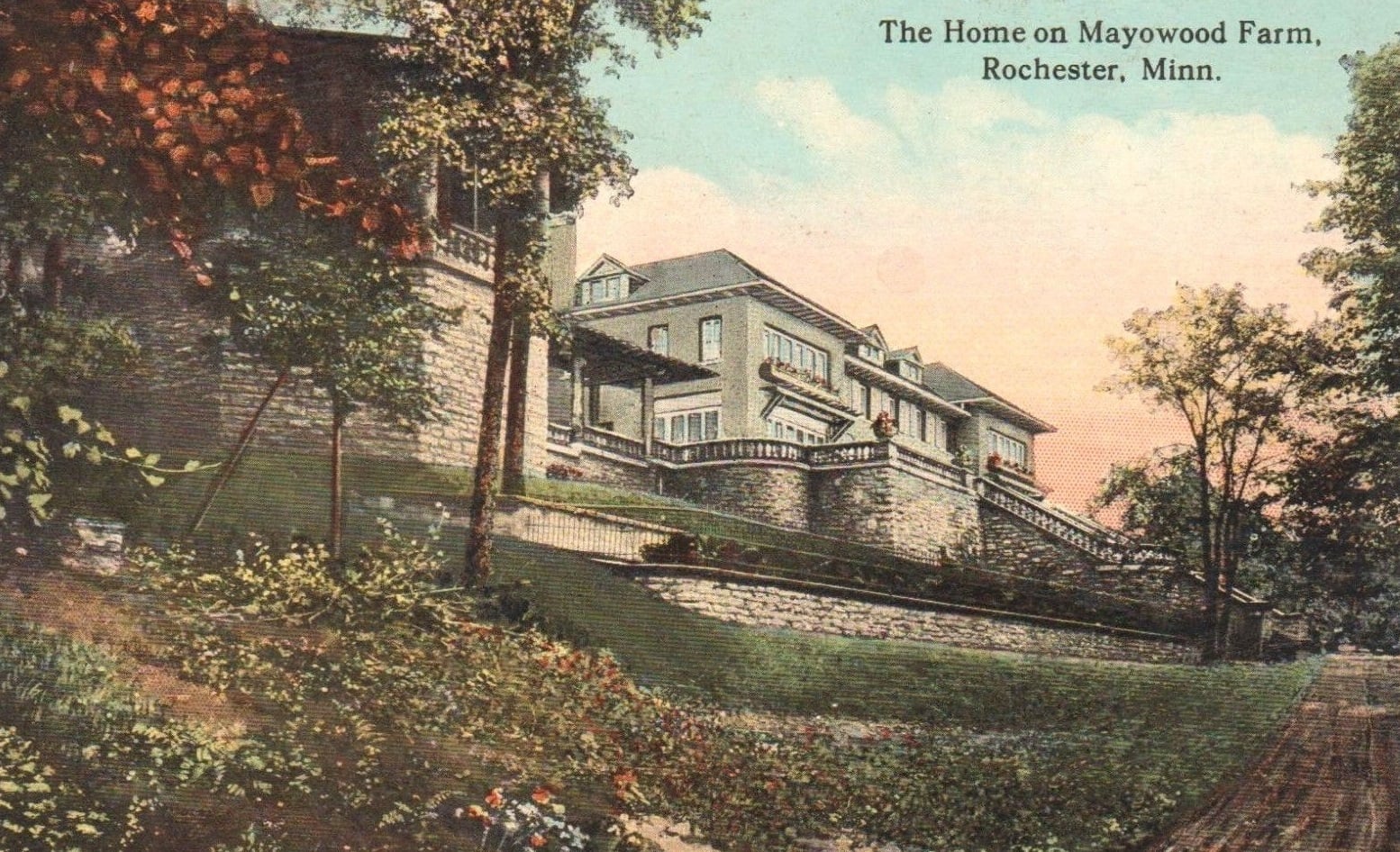
Mayowood Mansion in Rochester, Minnesota was the home of the family behind the Mayo Clinic. The lore holds that near a portrait of Joseph Mayo, killed by a train in 1936, visitors hear a single phrase answer back: deny it.
At Mayowood Mansion in Rochester, Minnesota, the story that follows people out of the house is about a portrait and a word. As the tale is told, visitors who stand near the painting of Joseph Mayo hear something answer them: "deny it." The ghost said to live in the house seems to argue with the idea that he's there at all.
Mayowood was built in 1910 and 1911 by Dr. Charles H. Mayo, who founded the Mayo Clinic with his brother, and his wife Edith. It was a working country estate of more than 3,000 acres, with a man-made lake, greenhouses, and farms, and a house of 38 rooms. Three generations of Mayo physicians lived there for roughly six decades, into the 1960s, at one point two generations under one roof at the same time, the home modified into something close to a duplex to fit them all.
The named ghost is Joseph Graham Mayo, Charles and Edith's son. On November 9, 1936, he was driving home alone from a hunting trip when a train struck his car at a crossing near Cochrane, Wisconsin. He was 34. His hunting dog died in the crash too, and by some accounts was buried with him. "Dr. Joseph G. Mayo, 34-year-old son of Dr. and Mrs. C.H. Mayo, was killed near Cochrane, Wis., when his automobile was hit by a train," the Rochester Post Bulletin reported.
The retellings around the house phrase his death loosely — shot, or hit by a train, as if the manner were uncertain. It isn't. The record is plain on the crossing in Wisconsin; the other version lives only in the ghost story.
Joe didn't die in the house. Neither did his father, who succumbed to pneumonia in Chicago three years later, two months after his own brother. The haunting belongs to the family, not to any room. Only Joe is named in it with any certainty.
The Mayos gave the mansion to the county historical society in 1965, and it went on the National Register of Historic Places in 1970. It stands today largely as they left it, the original paintings and personal things still in place, and it earned its own chapter in a collection called Ghosts of Southeastern Minnesota. You can tour it. Walk past Joe's portrait and, the lore holds, you may hear the one word the story keeps coming back to. Of every ghost said to refuse to leave a place, this one is reported to refuse the haunting itself.