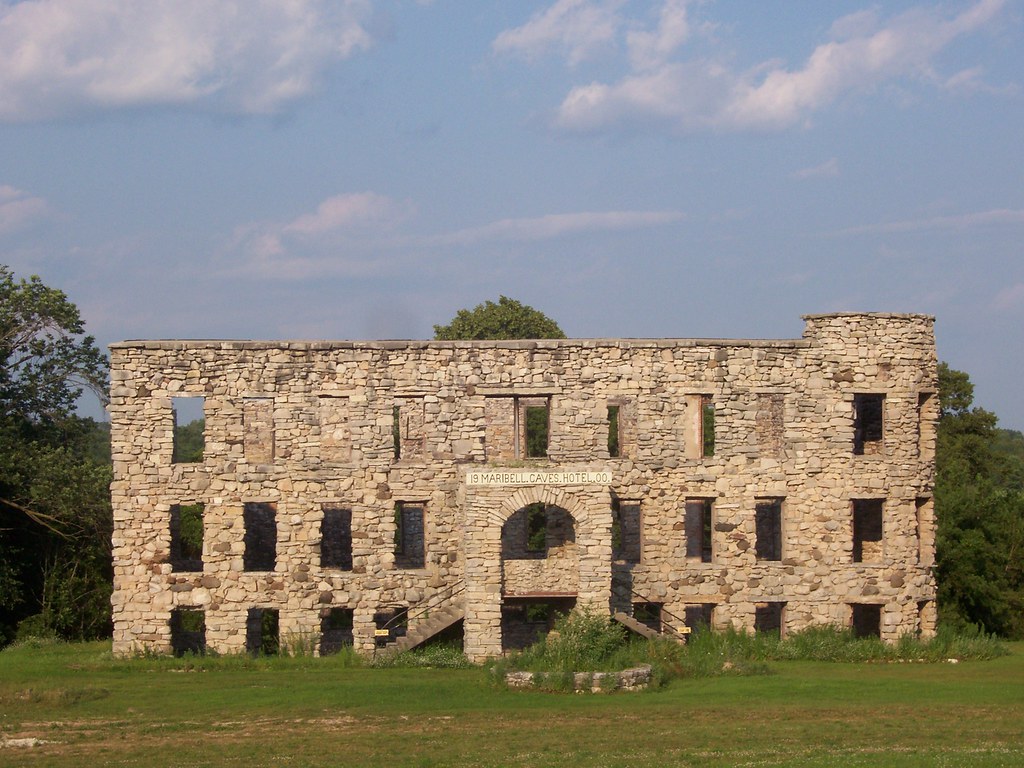
Known locally as Hotel Hell, this 1900 Austrian-inspired limestone resort in Manitowoc County was built by a Catholic priest, hosted Prohibition-era gangsters, burned three times, and was knocked down by a 2013 tornado. The gutted ruins still generate reports of shadows bouncing between windows, cold hands pressing on visitors' backs, and a flashlight test where something shines back from inside the empty building.
Shine a flashlight at a second-floor window of the Maribel Caves Hotel and something shines a light back at you. The building has been gutted since 1985. A tornado knocked most of it down in 2013. There's nobody in there.
The locals call it Hotel Hell, and the nickname has long overtaken the building's real name. The ruins sit at 15401 County Road R in Manitowoc County, limestone walls and a rounded tower rising out of the Wisconsin countryside like something transplanted from a European fairy tale. Which, in a way, is exactly what it was.
Charles Steinbrecher, an Austrian immigrant, dreamed of building a European-style mineral spring resort. His son Walter purchased the property in 1893. Another son, Father Francis X. Steinbrecher, a Catholic priest at St. Mary's in Kaukauna, made it happen. He recruited thirty stonemasons from his parish to build a resort using local limestone from the family's lime kilns. They finished in four months. The 450-acre resort opened in June 1900 with 42 guest rooms, an elegant dining room with decorative murals, dumbwaiters, and mineral water piped directly to the rooms. Over 200 guests could be found on any given day, enjoying fine bathing, boating, fishing, and tours of the limestone caves underneath. A bottling plant shipped the mineral water to Milwaukee, Chicago, and Minneapolis.
Father Steinbrecher died in 1927, and the resort's character changed fast. Prohibition turned it into something between a speakeasy and a roadhouse. Moonshiners and prostitutes replaced the health-seeking tourists. Family lore connects it to organized crime: descendant Sherry Dewane shared that one of her great-aunts "had gone out with one of Al Capone's men." Local legends claim Capone and Dillinger used the hotel as a hideout, running moonshine through the bottling plant and stashing treasure in underground passageways.
The building burned three times. Local legend insists the fires fell on the same date, with blazes in the 1920s and 1930. The most dramatic version claims that in the final fire, "everybody died in their sleep" and skeletal remains were found on the third floor and in the basement. These details can't be verified. What can be verified is the 1985 fire that destroyed the building's interior for good, and it was this fire that turned the ruins into a haunting destination.
The legends that grew around the empty shell are extravagant. The most outlandish claims that practitioners conducted secret rituals to curse the hotel and opened a portal to hell through the old fountain in front of the building. According to the legend, a practitioner of white magic sealed the portal, confining the spirits to the hotel grounds. Another legend tells of a guest who committed mass murder inside the hotel and then killed himself. None of this has documentary support. All of it has traction in Manitowoc County.
Tour guide Andy Krahn describes what he's seen: "If you stop outside on the road and you watch to the windows, you'll see a shadow bounce from window to window." Visitors report cold hands pressing on their backs on the third floor, blood appearing on walls, yelling from underground, and a bell ringing from inside the empty structure. Ghost sightings extend into the nearby Maribel Caves, the same limestone formations that once drew tourists to the mineral springs.
Richard Wagner, great-grandson of Charles Steinbrecher, keeps things in perspective. The only spirit his grandfather ever saw, Wagner said, was Charles Steinbrecher himself "walking around in his one-piece nightshirt." Manitowoc County Historical Society executive director Amy Myer has pointed out that Prohibition-era changes to rural establishments explain much of the darker reputation.
The ruins are on private property. The owner asks for respectful distance. A priest built a castle out of limestone for people who needed rest, and a century of fire, crime, folklore, and a tornado turned it into something else entirely.