At Historic Fort Snelling in St. Paul, visitors and staff report soldiers in old uniforms, marching and drumming where no one stands. The stories sit on top of a documented winter when up to 300 Dakota people died below the walls.
At Historic Fort Snelling in St. Paul, the figures people report are soldiers. Visitors and staff describe men in period uniform on the parade ground, the sound of marching and drumming carrying across grounds that are empty when you look. Discover Walks puts it plainly: the grounds are "claimed to be haunted by ghostly soldiers, and its stone walls are home to eerie voices." Footsteps, cold spots, strange smells — the accounts pass from one listicle to the next, and not one of them names a single spirit. There is no Charley here, no woman in a gown. Just men in old uniforms, drilling.
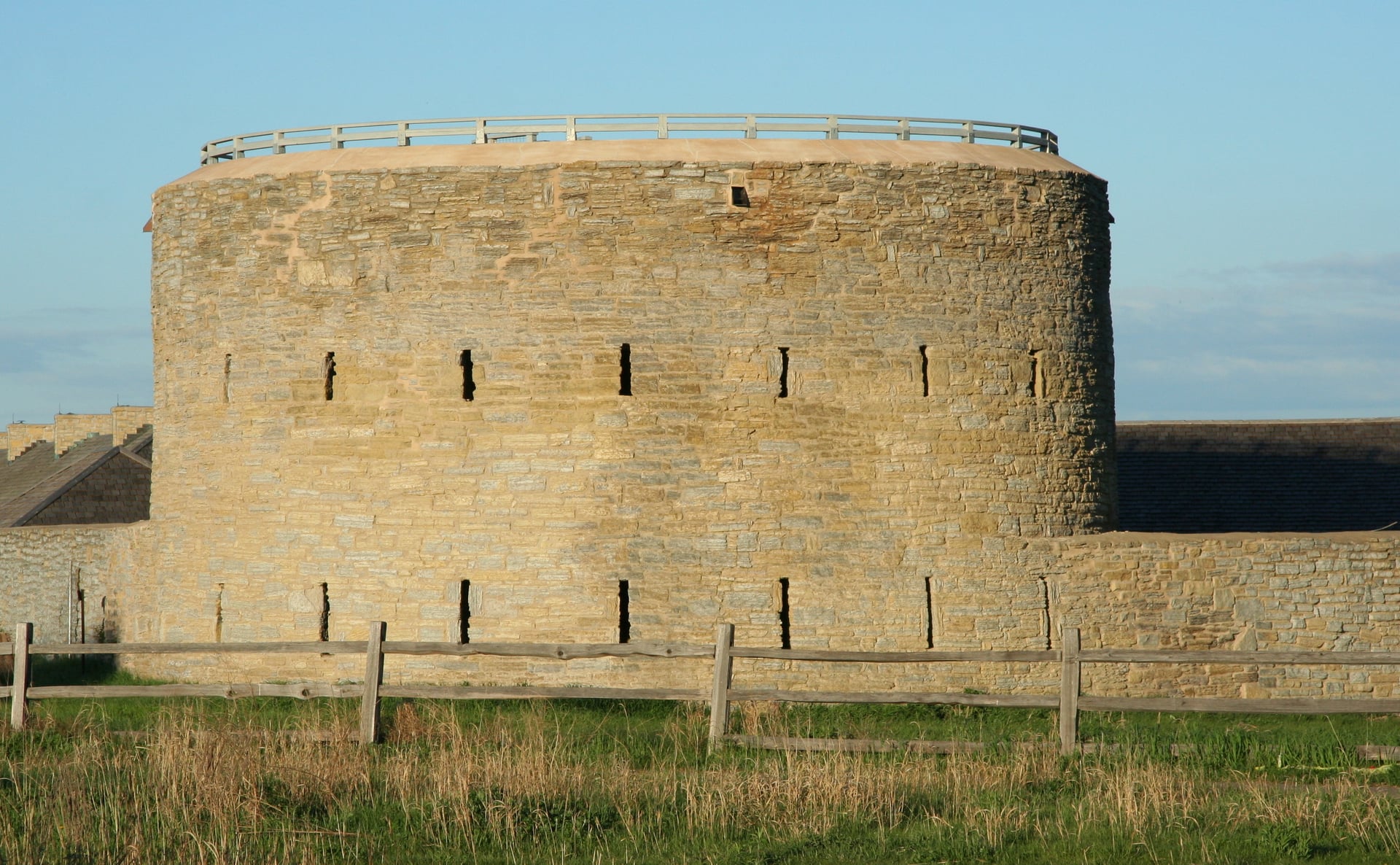
The fort is real enough. Construction began in 1819 and finished in 1825 on a bluff at the confluence of the Mississippi and Minnesota Rivers, on Dakota homeland known as Bdote. It was named Fort Saint Anthony first, then renamed for Colonel Josiah Snelling, who oversaw the work. In 1960 it became a National Historic Landmark, the first major military post in the region. The Round Tower, built in 1820, still stands — limestone walls more than 25 feet high, with musket slits cut to fire both outward and inward, a last redoubt for the day the outer walls fell.
The soldiers people report are easy to explain. The rest of what happened here is harder.
After the Dakota War of 1862, the army moved roughly 1,658 Dakota people to the fort that November, mostly women and children, and held them in an encampment on the river flats below the walls. Over the winter of 1862-63, somewhere between 102 and 300 of them died there, from the cold, from lack of food, from measles and cholera. The fort stood above them the whole time.
That history is why the ghost stories here keep coming back to it. The reported phenomena are soft, the kind that travel through folklore rather than the record. No primary news account documents a single encounter at the historic fort. What gives the stories their weight isn't any one figure on the parade ground. It's the ground itself, and what the winter did to the people held on it.
Today the site runs as a living-history museum under the Minnesota Historical Society, with a new visitor center in a restored 1904 cavalry barracks. The marching soldiers are the part the museum can answer for, uniforms and drills it puts on by daylight. The winter below the walls is the part it can't.