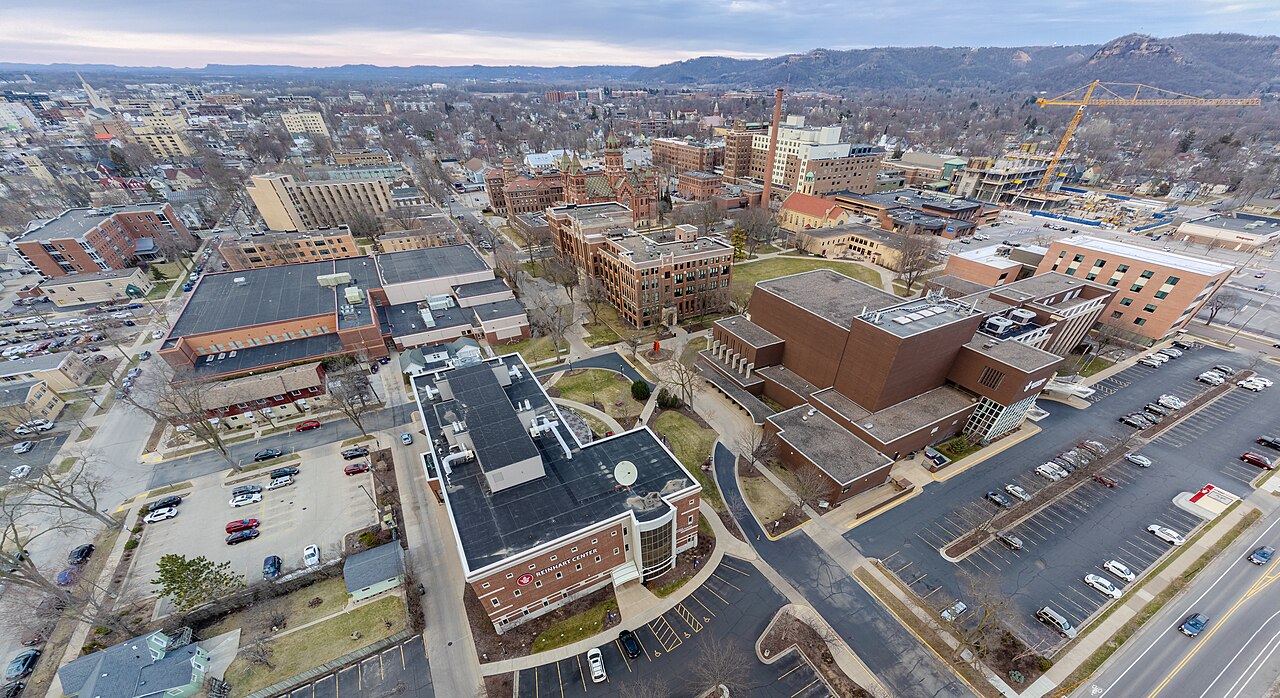
On the third floor of Heffron Hall at Saint Mary's University in Winona, Minnesota, students report rooms going ice-cold and knocking on locked doors that open to an empty hall. The university says the ghost was invented for a 1960s student paper.
On the third floor of Heffron Hall, a co-ed dorm at Saint Mary's University in Winona, Minnesota, students keep reporting the same things. Rooms that go ice-cold near 2 a.m. with the heater running full blast. Knocking on a locked door that gets louder and louder, until you open it onto an empty hallway. A resident named Melissa Fye described both. "It would start off really soft," she said of the knocking, "and eventually get so loud it sounded like someone was knocking on my door." Others on Third Heffron reported TVs switching on, a battery-less alarm clock that rang on its own, and a shadowy figure that slammed a locked door shut.
The university doesn't believe a word of it. "Officially, there isn't a ghost," a spokesperson told MPR News. "It was made up as hype for the college paper back in the '60s." In 1967, the student newspaper ran a Halloween edition called "Now It Can Be Told," handed out near midnight in a room set up with a coffin and spectral props. It became an instant collector's item, and the legend hardened from there.
The story stayed close to the building. For decades the ghost file lived under restriction in the campus library, guarded by the longtime archivist, Brother Paul Ostendorf. A journalist named Patrick Marek had lived in the alleged ghost room on Third Heffron for a semester in 1977; years later he got the first permission to write the whole thing down. His daughter ended up living on Third Heffron too.
Underneath the hoax sit two real deaths, both in the older St. Mary's Hall nearby. On August 27, 1915, a passed-over priest named Father Louis Lesches walked into Bishop Patrick Heffron's private chapel during morning Mass and opened fire. The bishop had refused to make Lesches a pastor, telling him he was too unstable for the work. One shot hit the bishop's thigh, one struck the tabernacle, and a final shot aimed at his heart was deflected by his own arm into his chest. He survived. A Winona jury deliberated about 45 minutes, found Lesches insane, and committed him to the state hospital for the dangerous insane. He stayed locked away until he died in 1943, after some 28 years confined.
Then, on May 15, 1931, Father Edward W. Lynch was found dead in his bed in St. Mary's Hall, his body charred as if it had burst into flame, the room around him untouched except for his burned Bible. The coroner blamed a defective lamp. Lesches was confined far away when it happened. The campus tied the death to him anyway.