The ghost most often described at Greystone Park Psychiatric Hospital outside Morris Plains, New Jersey is a nurse in white, still making her rounds. The trouble is that the building she walks was demolished in 2015. There is nothing left for her to round.
The ghost people describe most often at Greystone Park Psychiatric Hospital, outside Morris Plains, New Jersey, is a nurse in white, still making her rounds. Visitors and urban explorers tell of shadow figures, voices with no source, the feeling of being watched, a young girl in a pink dress, an unexplained greenish light. The lore is real, even if the closest firsthand account, an explorer down in the steam tunnels that once connected the wings, found "shrines with candles as well as graffiti, but no ghosts."
The building itself was meant to be the cure. Greystone opened on August 17, 1876, built on the Kirkbride Plan, the 19th-century theory of a Philadelphia Quaker physician that the right architecture could heal a sick mind. Light, air, fresh views, productive work, careful pacing through the halls. The reformer Dorothea Dix had spent years pressing New Jersey to build places where the mentally ill could be treated with dignity rather than jailed, and Greystone was meant to be one of them.
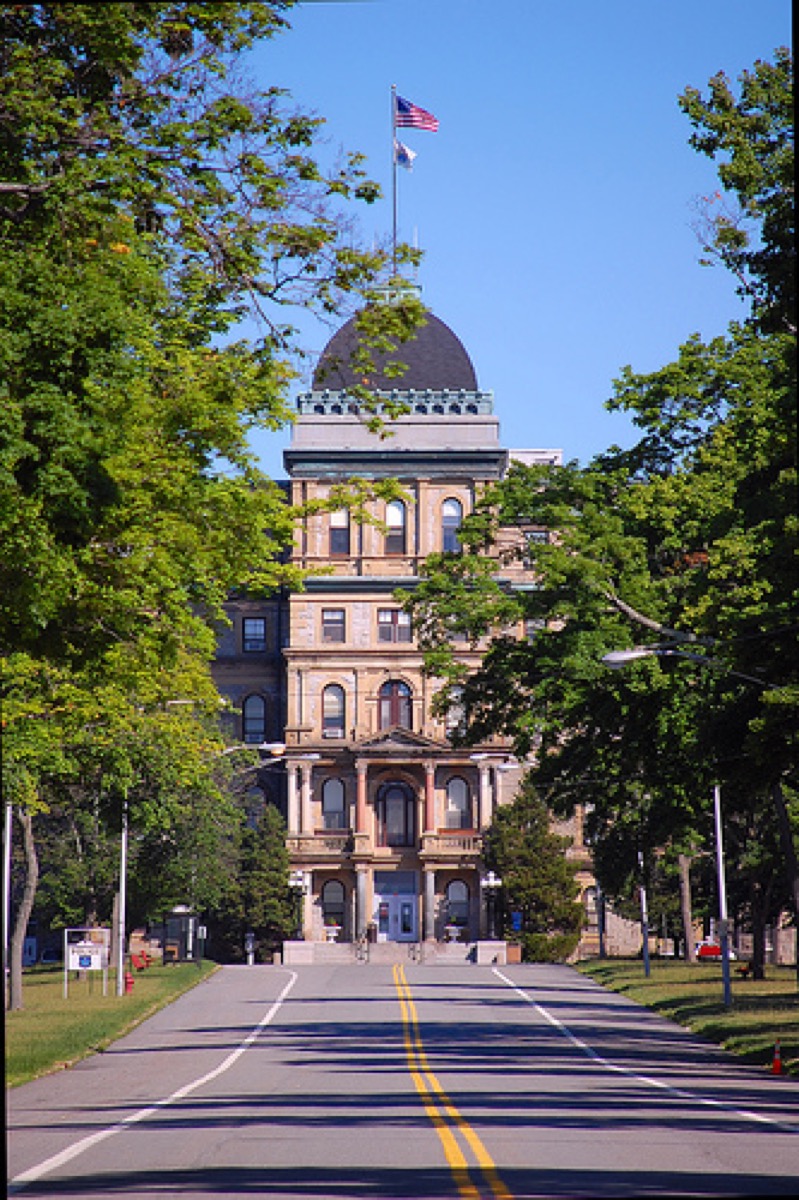
The main building rose from grey gneiss stone, Second Empire Victorian, 673,700 square feet of it, reputedly the largest single structure in the country until the Pentagon. The name came straight off the stone. The first day, 292 patients arrived from the overcrowded asylum at Trenton, moved between wings through tunnels so no one had to walk them outside.
It was designed for a few hundred. By 1953 it held 7,674, many of them sleeping in hallways and on dayroom floors. The theory failed in plain sight, and it failed for over a century.
In 1956 the folk singer Woody Guthrie was committed here after being picked up for vagrancy in New Jersey. He stayed five years, and it was at Greystone that doctors finally named what was killing him: Huntington's disease, missed for years before. He took to calling his ward "Wardy Forty." In early 1961 a 19-year-old Bob Dylan, just arrived in New York, came looking for his hero during those years. He wrote "Song to Woody" not long after.
The hospital closed in 2008. A preservation group fought for the Kirkbride, and a developer offered to restore the whole thing at no cost to the state. Both were turned down. Demolition ran from April to October of 2015, one of the largest losses of Kirkbride architecture the country has seen.
So the nurse in white is still making her rounds through halls that no longer exist. The corridors she walks were ground to rubble. There is nothing left standing for her to round.