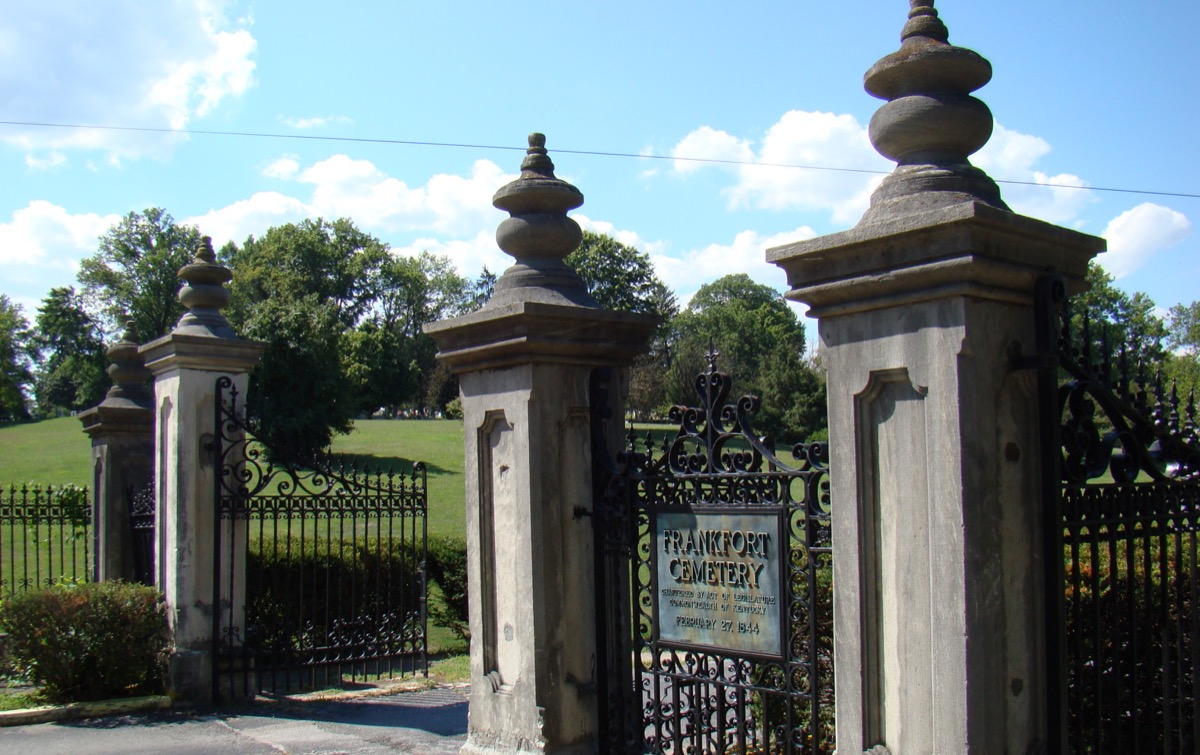
At Frankfort Cemetery in Frankfort, Kentucky, the grave under Daniel Boone's name may not hold Boone. A delegation dug him up in Missouri in 1845, and a skull cast later raised a doubt nobody has answered. Both states still claim him.
The oldest ghost story Kentucky tells about Daniel Boone has him leaving his grave at Frankfort Cemetery in Frankfort, Kentucky. The tale, collected in William Lynwood Montell's *Haunted Houses and Family Ghosts of Kentucky*, sends Boone's ghost out one stormy night to call on his dying friend Henry Clay. It's a fitting legend for a man whose final address nobody can agree on, because there's a real chance the grave doesn't hold him at all.
Boone died in Missouri in 1820 and was buried there beside his wife Rebecca, near Tuque Creek. He stayed in that ground for twenty-five years, ignored by the Kentucky he'd helped open. Then in 1845, a delegation traveled out, dug the couple up, and carried them back across the state line to a cemetery laid out on a bluff above the Kentucky River. The governor came. A crowd of dignitaries came. The state that had paid Boone no mind while he was alive held him an elaborate reinterment as soon as it could claim him dead.
The trouble is the graveyard they dug from was crowded and poorly marked, and enslaved people had been buried there alongside the Boone family. A legend took hold that the delegation lifted the wrong remains and carried a stranger home in Boone's place.
The whole dispute hangs on one object. The night before the 1845 reburial, someone made a plaster cast of the skull, and that cast still exists, on display at the Kentucky Historical Society Museum a short walk into downtown Frankfort. In 1983, forensic anthropologist David Wolf examined it and concluded the bones may have belonged to an African American man, not Boone, reading the brow ridges and the shape of the bone. A later expert countered that the cast was too degraded to prove anything either way.
So the question never closed. Both Frankfort and the old Missouri graveyard still claim Boone's body. By some accounts, the Friends of Daniel Boone's Burial Site in Missouri conceded only that the large bones moved north: "His heart and brain remain where he was buried."
The folklore never let him settle either. Montell's tale sends his ghost into a storm to sit with a dying friend; an Arthur Guiterman poem has him hunting mythical beasts across the Milky Way, forever in motion. A restless afterlife written for a man with two graves, a contested skull, and no one certain which ground actually holds him. The legend had it right before the forensics did.